




Table of Contents
- EUDI Wallet Consumer Survey
- What Does Selective Disclosure Mean (in Simple Terms)?
- Why 63% Is Actually a Conversion Number.
- What Consumers Will and Will Not Share and Why that Distinction Matters.
- The GDPR Connection: Data Minimisation Is Already the Law.
- The EUDI Wallet Opportunity in a Sentence.
- FAQs on Selective Disclosure
Ready to partner with IDnow?
Turn faces into trusted identities.
63% of consumers say they’re more likely to use the EUDI Wallet because of selective disclosure. Here’s why that number is really a conversion figure and what it means for your onboarding strategy.
Key takeaways:
- 63% of consumers are more likely to use the EUDI Wallet if it lets them share only what’s needed — rising to 74% among Gen Z and 70% among Millennials.
- Selective disclosure is not an optional feature: it is a core design principle of the EUDI Wallet under eIDAS 2.0.
- Consumers will share data for security and convenience (62% accept it for fraud protection) but not for commercial gain (only 18% accept it for marketing or advertising).
In Blog 1 of The Identity Gap EUDI Wallet series, we revealed that 46% of European consumers have abandoned a transaction because identity verification was too difficult, and that the EUDI Wallet’s ‘verify once, present everywhere’ model is the most credible structural fix. In this second piece, we look at the single feature that moves the adoption needle further than anything else in our dataset: selective disclosure.
Of all the findings from IDnow’s EUDI Wallet Consumer Survey report, one stands out. It’s not the revelation that only one in five are aware of what the EUDI Wallet is, nor that almost half of all consumers have abandoned an identity verification process. The single most actionable number in the entire dataset is this: when consumers were told that the EUDI Wallet would allow them to prove they are over 18 without revealing their name, address, date of birth, or any other detail, 63% said they would be more likely to use it.
This feature is called selective disclosure. Understanding its purpose does not require a technical background, but it does require an understanding of the value that customers place on it, what they’re afraid of, and what they’re willing to do when that fear is removed.
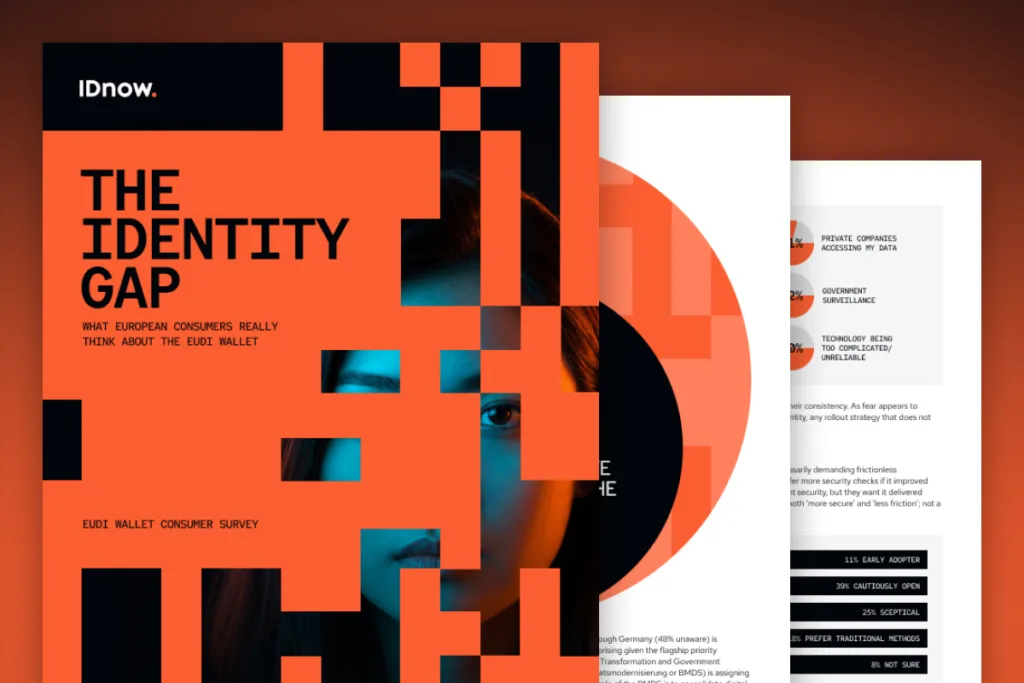
EUDI Wallet Consumer Survey
Download ‘The Identity Gap’ to discover what 2,000 European consumers really think about the EUDI Wallet, and what it means for banks, telcos, governments, and every organisation building their identity verification stack.
What Does Selective Disclosure Mean (in Simple Terms)?
Think about the last time you were asked to prove your age online. You probably uploaded a photograph of your passport or driving licence, and along with it handed over your name, address, date of birth, document number, and photograph, to confirm a single fact: that you are old enough to proceed.
The organisation asking the question needed one piece of information. You provided five.
Selective disclosure changes this. With the EUDI Wallet, a consumer can present a verified confirmation that they meet an age threshold (via a simple yes or no) without revealing anything else. No name. No address. No date of birth. The service receives the answer it needs and the customer retains everything else.
This is the principle at the heart of the EUDI Wallet: minimum data, maximum trust.
It sounds simple. The reason it has not existed at scale until now is that it requires a shared and trusted infrastructure, and a credential that any organisation can verify without needing to see the underlying document. The EUDI Wallet, mandated under eIDAS 2.0 across all 27 EU member states, provides exactly that infrastructure.
“The data from the EUDI Wallet Consumer Survey clearly shows that consumers value the ability to provide selectively disclosed attributes to protect their privacy. When consumers can share exactly what a service needs and nothing more, trust increases, conversion improves, and the regulatory burden of data minimisation takes care of itself. The IDnow Trust Platform is built to make this a reality at scale.”
Sebastian Elfors, Senior Architect, IDnow.
Why 63% Is Actually a Conversion Number.
The 63% uplift from selective disclosure is the highest single adoption driver identified in our research. Nothing else moves the needle as far, and the breakdown by age group makes the commercial case even clearer:
- Gen Z (18–29): 74% more likely to use the wallet with selective disclosure
- Millennials (30–45): 70% more likely
- Gen X (46–61): 63% more likely
- Boomers (62–80): 51% more likely
Even more than half of Boomers (the most sceptical age group) say they would be more likely to use the wallet if minimum data sharing were guaranteed.
This sends a very clear message to financial services, and it has direct business implications. The consumers most likely to respond to selective disclosure (Gen Z and Millennials) are also the most likely to abandon an onboarding flow when verification feels intrusive or excessive. Selective disclosure addresses the reason they leave. Institutions that lead with selective disclosure and that design onboarding flows around minimum data and promote that principle to customers will convert more of the people they are currently losing. Not because they have made verification easier, but because they have made it feel fairer.
The GDPR Connection: Data Minimisation Is Already the Law.
There is a regulatory dimension to selective disclosure that goes beyond the EUDI Wallet framework itself. GDPR requires that personal data be limited to what is necessary for the purpose of processing. In practice, this means that collecting a full date of birth to verify that a customer is over 18 is not just inefficient, strictly speaking, it is a compliance risk, as you are collecting more data than the purpose requires.
The current identity verification model creates this risk at scale. Every document upload, every selfie, every manual review collects and stores more personal data than the specific transaction demands. The cumulative data liability is significant, and largely invisible until something goes wrong.
Selective disclosure structurally resolves this. When a customer presents a wallet attribute confirming they meet an age threshold, no date of birth is transmitted, stored, or processed. The compliance obligation is met. The data liability does not arise. GDPR’s data minimisation principle is now satisfied by design, not by policy.
For legal, compliance, and data protection teams, this matters. Rather than building post-hoc data minimisation policies around a verification process that inherently over-collects, selective disclosure makes minimum data the default at the point of collection. The compliance posture improves not because the policy changes, but because the architecture does.
The EUDI Wallet Opportunity in a Sentence.
Selective disclosure is the feature that turns the EUDI Wallet from a compliance obligation into a competitive advantage. The 63% of consumers who say it would make them more likely to use the wallet are telling you exactly what to build and exactly how to communicate it.
Institutions that lead with data minimisation, design flows that request only what they need, and make that principle visible to customers will convert more, carry less data liability, and build the kind of trust that the EUDI Wallet’s rollout demands. The IDnow Trust Platform’s Decide layer is built around this principle and enables institutions to request only the specific attributes required for each transaction, present that request to customers in a way that makes the purpose clear, and deliver an onboarding experience that converts because it respects the customer’s data.
“The data tells a clear story: European consumers understand the problem that the EUDI Wallet is designed to solve, but they have not yet been convinced that this is the solution. They know that identity fraud is rising. They know that online verification is broken. They know that sharing more data than necessary carries real risk. What they have not yet seen is a solution they can trust, and that is precisely the gap the EUDI Wallet must close.”
Philippe Morel, CEO, IDnow.
The selective disclosure findings go deeper in the full report — including how data-sharing acceptability varies by purpose, age group, and market, and what the full breakdown of adoption drivers looks like across demographics. If you’re designing an onboarding flow for the EUDI Wallet era, this is the data you need.
Of course, selective disclosure only works if your integration supports every customer not just the digital-first ones. In Blog 3 of the Identity Gap EUDI Wallet series, we look at the onboarding preference data: 24% of consumers still prefer branch verification, 16% won’t open a bank account online at all, and digital wallets are already the second most popular method despite 51% of people having never heard of them.
FAQs on Selective Disclosure
What is selective disclosure in the EUDI Wallet?
Selective disclosure is the ability to share a specific, verified piece of information from an identity credential (e.g. proof that you are over 18) without revealing the underlying document or any additional personal data. It is a core design principle of the EUDI Wallet under eIDAS 2.0.
Why does selective disclosure matter for banks and financial institutions?
Selective disclosure directly addresses the most common reason consumers abandon identity verification: the feeling that they are being asked to share more personal data than the transaction requires. IDnow’s research shows that 63% of consumers are more likely to use the EUDI Wallet if selective disclosure is available, rising to 74% among Gen Z and 70% among Millennials. For banks, this is a measurable conversion opportunity.
How does selective disclosure help with GDPR compliance?
GDPR’s data minimisation principle requires that personal data be limited to what is necessary for the purpose of processing. Selective disclosure satisfies this requirement by design as only the specific attribute required for a transaction is shared, with no over-collection of personal data. This reduces data liability and simplifies compliance documentation without requiring additional policy work.
What data will consumers share through the EUDI Wallet?
IDnow’s research shows consumers are willing to share data when the purpose is clear and the benefit is tangible. 62% accept data sharing for fraud protection and 50% for avoiding repeated identity checks. However, acceptability drops sharply for commercial purposes, with just 18% for advertising. Institutions that request only what they need, and explain why, will see higher completion rates.
About the author

Jody Houton
Senior PR & Content Manager at IDnow
Jody Houton is a B2B content marketer at IDnow, where he creates and edits engaging content about KYC, fraud and digital identity. He also oversees the company’s public relations.
Connect with Jody on LinkedIn