



Table of Contents
- How Consumers Want to Open a Bank Account Today.
- Age Is [Not] Just a Number.
- Why the Wallet Is Already the 2nd Most Popular Method Even Among Those Who’ve Never Heard of It.
- What the Security–Friction Paradox Means for Onboarding Design.
- How to Please Everyone, All the Time.
- The Competitive Case for Getting This Right Now.
- Frequently Asked Questions About EUDI Wallet Integration.
Ready to partner with IDnow?
Turn faces into trusted identities.
24% of European consumers still prefer branch-based onboarding, while 16% won’t open a bank account online at all. Here’s why a successful EUDI Wallet integration must work for every customer.
Key takeaways:
- 24% of consumers still prefer in-person branch verification — the single most popular onboarding method, ahead of digital wallets (14%).
- Digital identity wallets are already the second most preferred onboarding method, despite 51% of consumers having never heard of the EUDI Wallet.
- 16% of consumers will not open a bank account online under any circumstances
- The only viable long-term strategy supports every verification method from a single orchestration layer — routing each customer to the right method for them.
In the ‘Identity Gap: Friction vs Conversion’ and ‘The Identity Gap: Privacy vs Compliance’ blogs, we explored why 46% of consumers abandon identity verification and how selective disclosure is the single most powerful adoption driver in our dataset. In this final piece, we turn to the practical question of how to build an integration strategy that works for your entire customer base.
As the EUDI Wallet has ultimately been designed to make identity verification faster, safer, and more portable, it would be a safe assumption that it will eventually replace all existing identity verification infrastructure. But this assumption misses a key point discovered in our research. Banks that build their integration strategy around this belief will find themselves with a compliance solution that works for some of their customers and a conversion problem with the rest.
The IDnow EUDI Wallet Consumer Survey Report reveals a customer base that is far more fragmented in its onboarding preferences than most digital transformation strategies account for. The data does not describe a market moving uniformly towards wallet-native verification. It describes a market that will require financial institutions to offer every method simultaneously — and will penalise those that cannot do so.
EUDI Wallet Consumer Survey
Download ‘The Identity Gap’ to discover what 2,000 European consumers really think about the EUDI Wallet, and what it means for banks, telcos, governments, and every organisation building their identity verification stack.
How Consumers Want to Open a Bank Account Today.
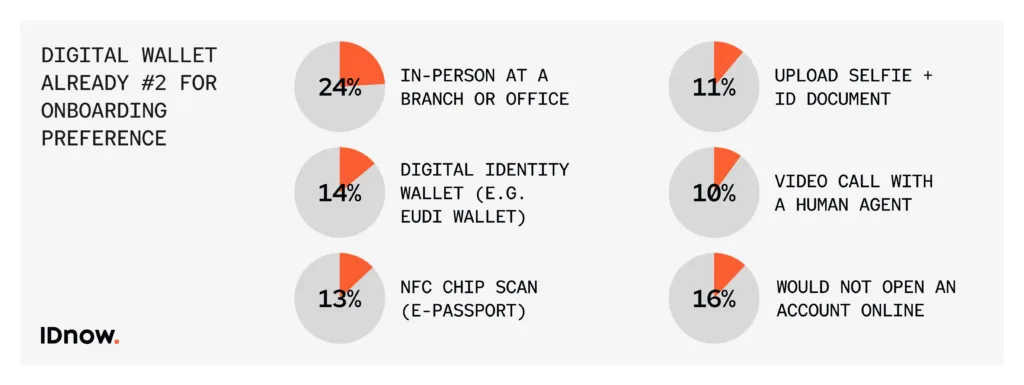
When consumers were asked how they would prefer to verify their identity when opening a bank account, the responses were far from consistent:
- 24% prefer in-person verification at a branch
- 14% prefer a digital identity wallet
- 13% prefer NFC chip scanning
- 11% prefer photo upload and selfie verification
- 10% prefer a video call with a human agent
- 16% would not open a bank account online at all
Read those numbers again.
The most popular onboarding method is still the physical branch. Interestingly, digital identity wallets are already the second most popular option, despite 51% of respondents having never heard of the EUDI Wallet, showing that consumers are interested in the concept before the product has even launched. Equally important is that 16% of consumers would not complete the process online under any circumstances. This should act as a stark warning that the market is not ready to abandon existing identity verification methods.
Age Is [Not] Just a Number.
Among Gen Z consumers (18–29), digital-first preferences dominate, but the picture is more nuanced than might be expected. Although they’re most likely to prefer wallet-based and NFC-based onboarding, and the least likely to want a branch visit, they’re also the most likely to abandon a transaction when verification gets in the way, with a 56% abandonment rate that reflects impatience with friction, not loyalty to any single method.
Among Boomers (62–80), the picture is almost inverted with branch preference highest and online lowest. A quarter of Boomers say they would not open a bank account online at all, compared to 16% across the full sample. Boomer awareness of the EUDI Wallet is also the lowest of any age group, at just 30%.
While the need to offer multiple identity verification methods will remain important for the foreseeable future, it’s also necessary to ensure any Wallet-onboarding strategy factors in multiple demographic differences. For example, while a strategy that is optimised for Gen Z may lead to increased adoption among that group, it may result in losing a significant portion of its older customer base. Likewise, a bank that maintains and/ or promotes just branch-only or document-upload-only verification will retain its Boomer customers and haemorrhage the younger ones who expect something faster and less intrusive.
Neither is really viable on a long-term basis. As such, the only successful long-term identity verification strategy is one that supports all of them, intelligently, from a single integration layer, such as the IDnow Trust Platform.
Why the Wallet Is Already the 2nd Most Popular Method Even Among Those Who’ve Never Heard of It.
The finding that 14% of consumers would choose a digital identity wallet as their preferred onboarding method despite 51% having never heard of the EUDI Wallet deserves particular attention.
It tells you that the concept already resonates with them now before rollout in December 2026. They understand the value proposition of verifying once, presenting wherever needed, and only sharing what is required.
For financial services, this should act as both an opportunity and a warning.
The opportunity is that when the EUDI Wallet launches and awareness begins to grow, the preference for wallet-based onboarding will almost certainly increase alongside it. The 14% who already prefer it as the top method of identity verification will likely be joined by a significant portion of the 51% who have never heard of it.
Equally as important to heed is the warning: that growth in wallet preference will not eliminate the other methods. In-person verification will still be the first choice for a substantial segment of a financial service’s customer base. Video calls will still be preferred by a meaningful minority. NFC chip scanning will grow — particularly among Gen Z — but will not become universal.
As such, the institutions that will survive in the future are not those that bet on a single method. They are those that offer an orchestration layer that routes each customer to the right verification method for them, at the assurance level the transaction requires, without any break in the journey.
What the Security–Friction Paradox Means for Onboarding Design.
There’s a stat from the EUDI Wallet Consumer Survey that potentially complicates the standard digital transformation narrative: 47% of consumers said they would prefer more identity checks, if it meant improved security. Nearly half of your potential customers are telling you they would rather wait longer and feel more secure than move faster and feel exposed. And that preference is broadly distributed across age groups.
The implication for onboarding design suggests that the goal is not necessarily to minimise the number of verification steps but to make each step feel proportionate, purposeful, and secure. Friction is verification that feels arbitrary, repetitive, or excessive. Assurance is verification that feels necessary, transparent, and trustworthy. The former drives abandonment. The latter builds the kind of customer relationship that survives the EUDI Wallet transition and everything that follows.
How to Please Everyone, All the Time.
The IDnow Trust Platform can seamlessly connect to every EU member state’s EUDI Wallet through just one API and handles the complexity of integration, compliance, and evolving standards so you can focus on delivering a trustworthy experience for every customer. In doing so, it allows financial services to:
- Accept EUDI Wallet credentials: verifying PID and attestations cryptographically, in real time, across all EU member states
- Support eID and NFC chip scanning: for the significant proportion of consumers who prefer chip-based verification, and for high-assurance scenarios where wallet credentials alone may not be sufficient
- Deliver document verification and biometric matching for customers not yet wallet-ready, for cross-border scenarios where wallet interoperability is still maturing, and for the fallback cases that every integration will encounter
- Offer video-assisted onboarding: for the 10% who prefer human-assisted verification, for high-value transactions that warrant additional assurance, and for customer segments where digital-only onboarding is not appropriate
- Route intelligently between methods: based on the customer’s device, location, the transaction’s assurance requirements, and the customer’s own preferences, without requiring the customer to understand the underlying logic
IDnow is independently certified to the highest identity assurance levels under eIDAS 2.0, actively participating in national pilots across France, Germany, and at European Commission level, and has the regulatory expertise to keep your integration current as standards evolve between now and December 2027 and beyond.
The Competitive Case for Getting This Right Now.
The institutions that move earliest to build full-spectrum onboarding will be able to offer a materially better customer experience than those that treat the EUDI Wallet as a checkbox and leave everything else unchanged. They will also have a data advantage. Every onboarding interaction that passes through an orchestrated, intelligent verification layer generates signals — about customer preferences, about where friction occurs, about which methods convert and which do not.
“Trust is earned through transparency and demonstrated security. The fact that banks lead governments in consumer trust reflects decades of investment in secure, reliable financial infrastructure. The EUDI Wallet ecosystem needs to build on that foundation, not compete with it.” Uwe Stelzig, Managing Director DACH, IDnow
One size fits none. The banks that build for every customer — not just the digital-first ones — will be the ones that consumers trust with their identity when the EUDI Wallet arrives. And trust, as the data consistently shows, is the only thing that drives adoption at scale.
You’ve reached the end of The Identity Gap series. If you’ve found this useful, the full report goes further — with data broken down by market, age group, and awareness level across all seven chapters. Download it now, or revisit the series from the beginning:
The Identity Gap: Friction Vs Conversion. What the EUDI Wallet Will and Won’t Fix Tomorrow.
Frequently Asked Questions About EUDI Wallet Integration.
What are the most popular identity verification methods for bank onboarding in Europe?
According to IDnow’s 2026 consumer research, in-person branch verification is still the most preferred onboarding method (24%), followed by digital identity wallets (14%), NFC chip scanning (13%), and photo upload with selfie (11%), and video calls with human agents (10%). 16% of consumers say they would not open a bank account online at all.
Will the EUDI Wallet replace existing identity verification methods?
No. The EUDI Wallet will become a mandatory acceptance requirement for regulated businesses by December2027, but it will not replace existing verification methods. A significant proportion of consumers — particularly older demographics — will continue to prefer branch-based, video-assisted, or document-based verification. Banks need to support all methods from a single orchestration layer.
What is the EUDI Wallet customer onboarding process?
EUDI Wallet onboarding allows a customer to present a verified credential, such as their Person Identification Data (PID), directly from their wallet. The receiving institution verifies the credential cryptographically in real time, with no document upload or manual review required. The customer can selectively disclose only the attributes required for the specific transaction.
How should banks design their EUDI Wallet integration strategy?
Banks should build — or integrate with — an orchestration layer that supports the full spectrum of verification methods: EUDI Wallet credentials, eID and NFC chip scanning, document verification and biometric matching, and video-assisted onboarding. For example, the IDnowTraut Platform routes each customer to the right method based on their device, location, transaction assurance requirements, and preferences.
What is the IDnow Trust Platform?
The IDnow Trust Platform is an identity orchestration solution that connects organisations to every EU member state’s EUDI Wallet through a single API, with intelligent routing across the full spectrum of verification methods — wallet-native, eID, NFC, document, and video-assisted. IDnow is independently certified to the highest eIDAS 2.0 assurance levels and is actively involved in EUDI Wallet development at national and European Commission level.
About the Author

Jody Houton
Senior PR & Content Manager at IDnow
Jody Houton is a B2B content marketer at IDnow, where he creates and edits engaging content about KYC, fraud and digital identity. He also oversees the company’s public relations.
Connect with Jody on LinkedIn