



Table of Contents
Ready to partner with IDnow?
Turn faces into trusted identities.
In the first of our three-part ‘Everything You Need to Know About the EUDI Wallet’ blog series, we explain what the EUDI Wallet is, what data it contains, and why the 2027 deadline is one no bank can afford to miss.
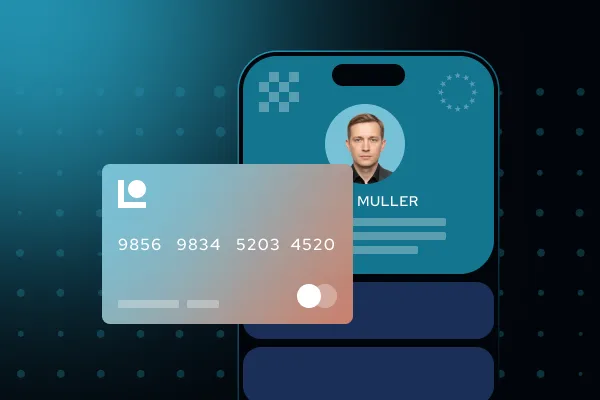
Imagine being able to access your passport, driving licence, bank account credentials, and proof of age and address – basically, your whole digital identity – from your smartphone. That’s the vision behind the European Union Digital Identity Wallet, or EUDI Wallet (pronounced You-dee Wallet, by the way…).
Proposed by the European Commission in 2021, the EUDI Wallet is perhaps Europe’s most ambitious digital infrastructure project. It is no exaggeration to say that it will completely change how Europeans use and think about their digital identity, and it’s happening very soon.
In our 2026 EUDI Wallet Consumer Survey, we found that digital identity wallets are already the second most preferred onboarding method among European consumers, even though 51% have never heard of the EUDI Wallet. The challenge isn’t demand; it’s awareness.
In fact, every EU member state must offer at least one government-issued, interoperable wallet to its citizens by December 2026. Specified private-sector relying parties — including banks, financial services providers, and payment institutions — must then be capable of accepting them by December 2027.
As identity verification is the bedrock of customer onboarding, anti-money laundering (AML) compliance, and Know Your Customer (KYC) processes, the question isn’t whether the EU Digital Identity Wallet will change how your bank verifies identity, it’s whether they will meet the fast-approaching deadline.
“The EUDI Wallet is not simply a new digital product — it’s a fundamental shift in the trust architecture that underpins identity verification across Europe. For banks, the institutions perhaps most reliant on robust identity verification, understanding and preparing for it is not optional.“
Liudmyla Rabchynska, Director of Global Regulatory and Government Affairs, IDnow
EUDI Wallet Consumer Survey
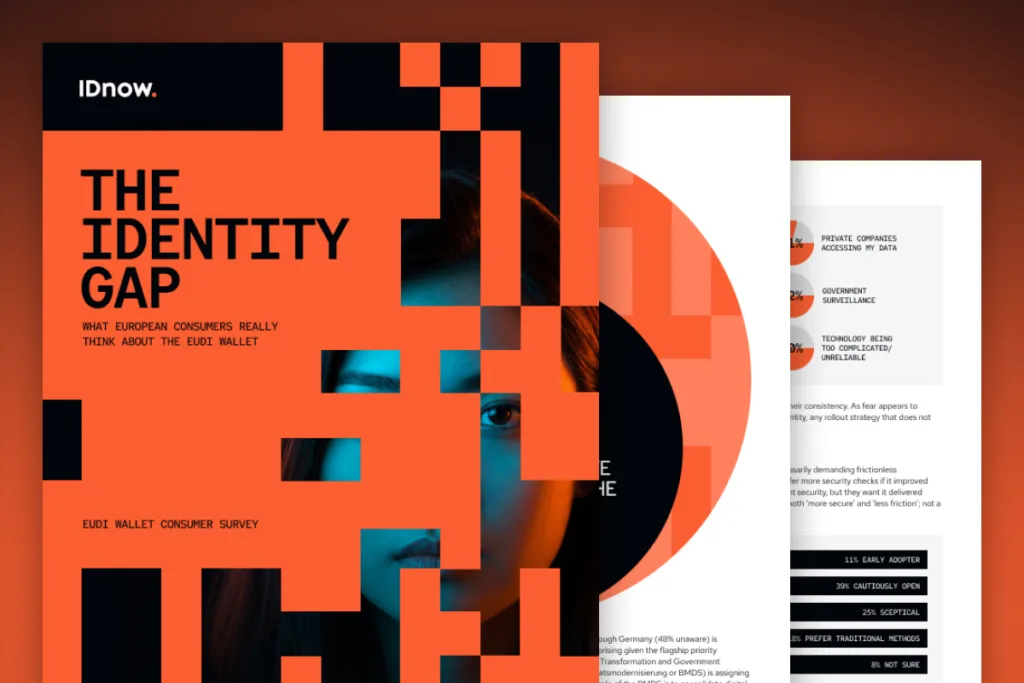
Download ‘The Identity Gap’ to discover what 2,000 European consumers really think about the EUDI Wallet, and what it means for banks, telcos, governments, and every organisation building their identity verification stack.
What Does an EUDI Wallet Actually Contain?
The European Digital Identity Wallet is designed to be a secure digital container for multiple types of verified data. It contains:
Person Identification Data (PID)
The foundational layer — verified identity attributes such as name, date of birth, nationality, and address. PID is issued by government authorities and forms the basis upon which all other credentials are built. For banks, PID is the equivalent of seeing a verified, government-issued ID document — except it’s cryptographically authenticated and cannot be forged.
Electronic Attribute Attestations (EAAs and QEAAs)
Above the PID layer sit attestations — credentials issued by either public or private bodies that confirm specific attributes. A Qualified Electronic Attribute Attestation (QEAA) carries the highest level of trust, equivalent to a notarised document in the physical world. For banks, these attestations could confirm a customer’s tax identification number, proof of residence, or professional qualifications — all pre-verified and instantly readable.
NFC Chip Data
In 2025, under EU Regulation (EU) 2025/1208, private-sector organisations were, for the first time, able to access the data stored on NFC chips embedded in biometric passports and identity cards — specifically DG1 (biographical data) and DG2 (facial image). This is a significant development that bridges the physical and digital worlds of identity. IDnow already offers NFC-based identity verification, and the EUDI Wallet framework builds on this capability as a trust anchor for PID issuance.
For a deeper dive into NFC-enabled identity verification and what it means for compliance, see IDnow’s blog: ‘Chips in: Why it’s time to tap into NFC-enabled identity verification.’
How the EUDI Wallet Will Change Identity Verification for Banks
By the end of 2027, the European ID Wallet will be involved in virtually every part of the customer lifecycle in financial services, including, but not exclusively:
Customer Onboarding and KYC
Today, opening a bank account — especially online — typically requires a combination of document scanning, video identification, and manual review. With the EUDI Wallet, a verified PID can replace all these steps. A customer wanting to open an account presents their wallet credential, the bank’s system verifies its authenticity cryptographically in real time, and onboarding is complete. As there are no document uploads, no video calls, and no waiting for manual review, the EUDI Wallet has the potential to reduce onboarding times, and drop-off rates dramatically.
Ongoing Authentication
EUDI Wallets will also change how returning customers authenticate themselves. Instead of passwords, SMS codes, or proprietary banking apps, customers will authenticate using their wallet — a single, phishing-resistant, government-backed credential. For banks wrestling with fraud losses linked to credential theft and account takeover, the EUDI Wallet is a significant security upgrade.
Cross-Border Account Opening
Perhaps the most transformative use case for banking is cross-border onboarding. For example, right now, a Spanish national opening a bank account in Germany must navigate two different regulatory environments and present documents that may not be instantly recognisable to the German bank. As such, the customer must potentially go through enhanced due diligence. However, with an EUDI Wallet, as the PID is already verified to a harmonised European standard, the bank knows it can trust what it’s receiving, regardless of where the customer comes from.
Payments with Strong Customer Authentication (SCA)
The EUDI Wallet is designed to support Strong Customer Authentication, which is line with the core requirements of the PSD2 (Second Payment Services Directive) and the upcoming PSD3 and PSR (Payment Services Regulation). Wallet-based SCA is expected to be more secure and convenient than current authentication methods, which will theoretically create new payment flows that are frictionless for customers and audit-ready for regulators.
EUDI Wallets: One of Three Trusted AMLR Pathways.
As part of the EU’s broader Anti-Money Laundering Regulation (AMLR) — currently progressing through the legislative pipeline and expected to apply by July 10, 2027 — EUDI Wallets will be formally recognised as one of three accepted methods for remote customer identity verification, alongside eID Schemes and Qualified Trust Services.

Deploy Trust Your Way
National Electronic Identification (eID):
National electronic identification schemes already notified under the original eIDAS framework (e.g., Germany’s existing eID, France’s France Connect+) will continue to be valid under AMLR but operate at national rather than pan-European level.
Discover how the IDnow Trust Platform can seamlessly integrate eID Schemes into your workflows to deliver scalable, compliant onboarding.
EUDI Wallet:

EUDI Wallets are government-issued digital wallets that are compliant with eIDAS 2.0 and contain verified Person Identification Data (PID) and attestations. EUDI Wallets will be considered as the highest level of trust within the AMLR framework for digital identity.
Discover how the IDnow Trust Platform can bring EUDI Wallets into your onboarding flow with one integration, giving you verified, reusable digital identities at scale.
Qualified Trust Services:
Qualified Trust Services are services such as Qualified Electronic Signatures (QES) and Qualified Electronic Seals that issued by Qualified Trust Service Providers listed on national Trusted Lists. Such services are used in document signing and authentication processes and carry strong legal weight.
Discover more about our IDnow Qualified Trust Services.
It’s worth noting that as not every customer will have an EUDI Wallet at rollout, national eID systems will remain the primary channel for many users for years to come. As such, a truly AMLR-ready bank is one that can accept all three methods, seamlessly, for any customer, from any EU member state.
^“The AMLR framework gives banks clarity, but it also raises the compliance bar considerably. Institutions that can only accept one type of digital identity by 2027 will face significant gaps in their customer coverage. The goal must be interoperability across all three accepted methods,” said Liudmyla Rabchynska, Director of Global Regulatory and Government Affairs at IDnow.
Is Your Bank EUDI Wallet-Ready? What to Do Before 2027
As both a technology provider and an active participant in shaping the frameworks that will govern the EUDI Wallet — through LSPS, through ETSI and CEN standardisation work, and through direct engagement with European regulatory bodies — IDnow can help financial institutions enter the EUDI Wallet and AMLR era with ease.
The IDnow Trust Platform brings together market-leading fraud signals and the broadest set of identity verification methods on the market (including each of the three AMLR-recognised methods of identity verification), allowing organisations to meet eIDAS 2.0 and AMLR requirements out of the box, with a certified platform that regulators already trust. Plus, thanks to IDnow’s broad portfolio of verification methods, fallback flows ensure onboarding never stops, even when a wallet cannot be used.
FAQ: Everything Else You Need to Know about EUDI Wallets
Is the EUDI Wallet mandatory for banks?
By December 2027, specified relying parties — which include banks and financial services firms that use strong customer authentication — will be required to accept EUDI Wallets. This is a hard deadline, not a soft target.
Will every EU citizen have an EUDI Wallet by 2026?
Every EU citizen must have access to at least one government-issued EUDI Wallet by December 2026 — but access doesn’t mean adoption. The Commission’s 2030 Digital Decade target is for 80% of EU citizens to use a digital ID solution; getting there will require sustained public awareness campaigns and a critical mass of use cases that make adoption worthwhile. Banks should plan for mixed populations of wallet and non-wallet customers for several years post-launch.
Can wallets from different countries be used interchangeably?
In principle, yes — interoperability is a core requirement of the EUDI Wallet framework. In practice, early-stage implementations may have gaps, and banks will need acceptance infrastructure that can handle the variation. This is exactly the problem that projects like Wallet Forum and APTITUDE are working to solve.
Is an EUDI Wallet credential as legally valid as a physical ID?
EUDI Wallet credentials issued by certified government authorities carry the same legal weight as their physical equivalents under EU law. For KYC and AML purposes, a verified PID from an EUDI Wallet meets the requirements for identity verification at the highest assurance level.
What happens if a customer doesn’t have an EUDI Wallet?
It’s likely that even after the EUDI Wallet deadline of 2027, some customers either won’t have an EUDI Wallet or will want to use an alternative identity verification method. It is therefore imperative that banks offer other options, including eID systems and, where appropriate, physical document-based processes.
How does the EUDI Wallet handle data privacy?
The EUDI Wallet is designed with GDPR compliance at its core. For example, selective disclosure means customers control exactly what data is shared with a relying party for each transaction. As transaction logs are stored in the user’s wallet, not on centrally held government servers, they do not enable tracking of user behaviour across relying parties. Consumer appetite for this feature is striking: Our EUDI Wallet Consumer Survey found that 63% of European consumers say they would be more likely to use the Wallet if it allows them to share only what’s needed. A figure that rises to 74% among Gen Z and 70% among Millennials.
What is the Architecture and Reference Framework (ARF)?
The ARF is the technical specification — developed jointly by the European Commission and member state experts — that defines how all EUDI Wallets must be built and how they must communicate with relying parties. Compliance with the ARF is a prerequisite for wallet certification. Banks implementing acceptance infrastructure need to build against the ARF specification.
How does this affect IDnow’s existing video identification processes?
Regulated video identification remains a valid and accepted form of identity verification. As EUDI Wallets roll out, video identification is likely to become more relevant as a fallback or supplementary method for cases where wallet credentials are insufficient (e.g., where liveness verification is required in addition to PID). IDnow supports both, ensuring continuity for clients and their customers.
Should we start our EUDI Wallet readiness programme now?
Yes. Even though the deadline is December 2027, for a major financial institution, building acceptance infrastructure, updating AML policies, training teams, and integrating with national trust registries takes time. Banks that begin now will be ready for the deadline. Banks that wait until 2027 will not.
Want to learn more?
The EUDI Wallet is the biggest shift in European identity verification in a generation. IDnow is here to make sure your institution doesn’t get left behind.
In the next blog in the ‘Everything You Need to Know About EUDI Wallet’ series, we assess how ready each of the 27 EU member states are and what that means for your 2027 compliance planning.
About the author

Jody Houton
Senior PR & Content Manager at IDnow
Jody Houton is a B2B content marketer at IDnow, where he creates and edits engaging content about KYC, fraud and digital identity. He also oversees the company’s public relations.
Connect with Jody on LinkedIn