



Table of Contents
Ready to partner with IDnow?
Turn faces into trusted identities.
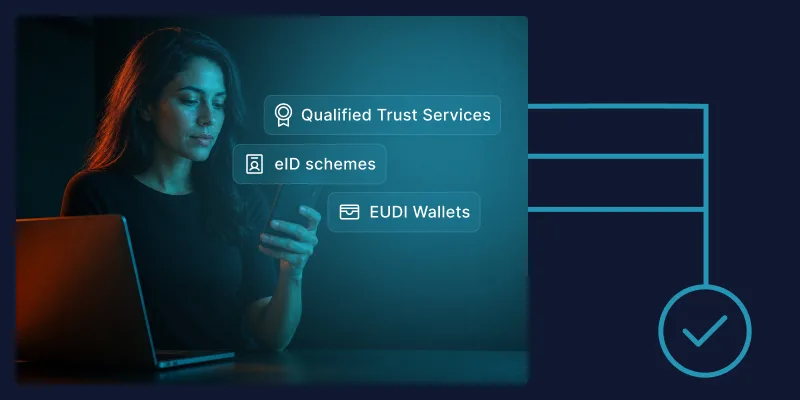
IDnow runs every AMLR-recognised identity verification method behind one integration and takes the operational load off your team. Qualified Trust Services, eID schemes, and EUDI Wallets are all orchestrated through the IDnow Trust Platform, with automatic routing, built-in fallback, risk-based fraud friction, and full-lifecycle identity management. IDnow also carries the EUDI Wallet relying-party work, so each new national wallet arrives as a configuration switch. One platform. Every method. The complexity managed for you.
AMLR has settled which methods count; the open question for buyers is who runs all of them at once so the burden does not land on your team. For what to look for on this criterion, see our companion guide on selecting a versatile, single-gateway IDV setup.
The IDnow approach: coverage is table stakes, management is the product
AMLR named the methods, and that is genuinely useful. AMLR (Regulation (EU) 2024/1624) applies directly across all EU Member States from 10 July 2027, replacing the patchwork of national AML rules with a single rulebook Regulation (EU) 2024/1624 on EUR-Lex. Its Article 22 sets the customer due diligence obligations that govern how you identify and verify a customer before a business relationship begins. Qualified Trust Services (automated and video-based document verification), eID schemes, and EUDI Wallets are the recognised routes for compliant remote identity verification, alongside QES and QEAA. The ambiguity about which methods count is largely resolved.
Harmonisation did not remove the implementation challenge, it concentrated it. Regulated institutions must be capable of offering all three categories as a compliance baseline, while eID schemes and EUDI Wallets take years to reach real consumer adoption and document verification stays dominant in the meantime. Fraud is accelerating, UX expectations are rising, and customers want onboarding that is fast and trustworthy at the same time.
IDnow treats that operating environment as the actual product problem. The differentiator is not how many methods a vendor lists, it is whether the vendor absorbs the complexity or hands it back to you. The Trust Platform is built to absorb it.
How it works
One integration, every method
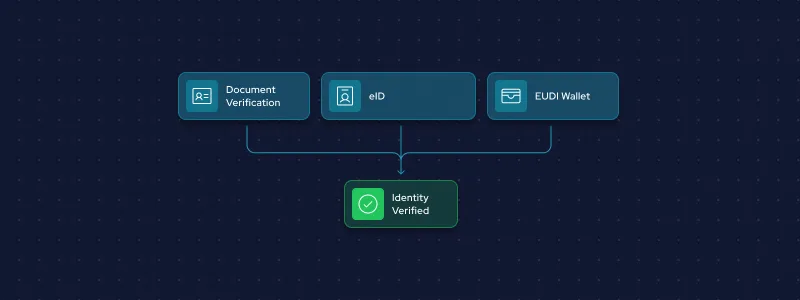
The Trust Platform connects to your product through a single API. Behind it sit the methods your business is likely to need:
Adding any method to your flow does not require a new integration. The engineering you do once keeps serving you as regulation and adoption evolve.
Fallback built into the flow architecture
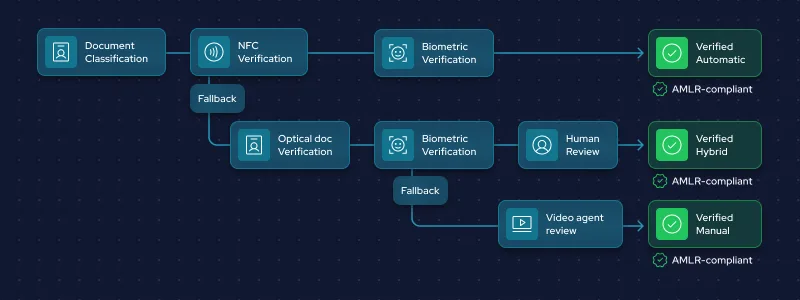
Primary methods fail for ordinary reasons: a device without NFC, an eID scheme unavailable in a market, a document outside the standard set, or a technical environment where liveness is unreliable. With a point solution, that failure ends the journey and creates a manual exception. On the Trust Platform, fallback is designed into the flow.
The platform routes each user to the method that fits their context, based on device capability, country, document type, and risk profile. A user who cannot complete NFC verification moves to OCR document verification; a user who cannot complete automated verification moves to a hybrid or video flow. The verification still happens and the journey holds. Every recovered session is a conversion you would otherwise have lost.
Risk-based fraud friction, applied automatically
Compliance is one axis; fraud prevention and customer experience are the other two, and they pull in different directions. The answer is to apply the right level of friction to the right person at the right moment. Genuine customers move through a verification flow matched to their context, quickly and without unnecessary steps. Where fraud signals or elevated risk indicators appear, the platform adds friction: hybrid review, additional liveness checks, or a higher-assurance method. The difference stays invisible to the legitimate user and consequential for the fraudster.
Identity across the full customer lifecycle
Identity is not a one-time event. AMLR treats customer due diligence as an ongoing obligation, not a single check at onboarding. Customers return, risk profiles change, and regulated institutions need re-verification, step-up authentication for higher-risk transactions, and continuous monitoring. The Trust Platform is designed for the full lifecycle, not only the front door.
Why this is hard to replicate
The hardest part of AMLR readiness is the EUDI Wallet adoption gap. Under eIDAS 2.0 (Regulation (EU) 2024/1183), Member States must make at least one wallet available to citizens by the end of 2026, and regulated relying parties such as banks must accept EUDI Wallet credentials by December 2027 Baker McKenzie on the EUDI Wallet timeline. Consumer adoption will lag that deadline for years; the EU’s Digital Decade target of 80% of citizens using a digital ID by 2030 signals the intended scale, and the 2027 reality will fall well short of it European Commission Digital Decade target, via IDnow. So institutions must accept wallets for compliance while still serving most users through document verification and eID schemes.
Wallet acceptance is not a single switch. Each national wallet a relying party wants to accept brings its own onboarding and technical alignment, and doing that independently across Member States is a standing operational burden. IDnow carries that relying-party work on customers’ behalf, so a new national wallet becomes available through the Trust Platform without a separate integration project on your side. A vendor without this hands the backlog back to you. That is the gap to probe in any procurement.
FAQs
What are the AMLR-recognised methods for remote identity verification?
AMLR recognises Qualified Trust Services (automated OCR and NFC document verification, plus video identification), eID schemes at LoA substantial or high, and EUDI Wallets. QES and QEAA are also set out in the framework. These categories are defined and stable.
Do regulated institutions need to support all AMLR categories?
Institutions need to be capable of offering the recognised routes from 10 July 2027. In practice, eID schemes and EUDI Wallets take years to reach meaningful adoption, so document verification stays dominant and institutions must support the full range at once, not in sequence.
When does EUDI Wallet acceptance become mandatory?
Under eIDAS 2.0, Member States must make at least one wallet available by the end of 2026, and regulated relying parties such as banks must accept EUDI Wallet credentials by December 2027. Wallet availability and consumer adoption will vary by Member State, so 2027 coverage will be uneven.
What is EUDI Wallet relying-party onboarding and why does it matter for IDV vendors?
To accept a national EUDI Wallet, a relying party must complete the registration and technical alignment that wallet requires. Doing this for every national wallet across Member States is a significant burden. IDnow manages it on customers’ behalf, so new wallets become available through the Trust Platform without a separate project.
What is fallback verification and why does it matter?
Fallback verification covers what happens when the primary method cannot complete because of a user’s device, country, document type, or a technical limit. Without built-in fallback, that failure means a lost conversion. The Trust Platform routes users automatically to the most appropriate alternative, so verification completes even when the first choice is unavailable.
How does identity verification relate to fraud prevention?
Identity verification is part of a broader fraud strategy. The Trust Platform applies risk-based decisioning across the flow: genuine customers get a fast, low-friction journey, while sessions with elevated fraud signals trigger liveness checks, hybrid review, or a higher-assurance method. This extends across the full lifecycle, not only onboarding.
What does full customer lifecycle identity management mean?
AMLR treats customer due diligence as ongoing. After onboarding, customers return for higher-risk transactions, circumstances change, and rules may require re-verification or step-up authentication. Full lifecycle management means ongoing identity assurance, including continuous monitoring and re-verification, not just the initial check.
The methods are set. The burden is running all of them at once, across a user base with rising expectations and a threat landscape that is not standing still. That is what the Trust Platform is built to carry. One platform. Every method. The complexity managed for you.
See how the Trust Platform manages verification complexity across every AMLR-recognised category: Explore IDnow