



Table of Contents
Ready to partner with IDnow?
Turn faces into trusted identities.
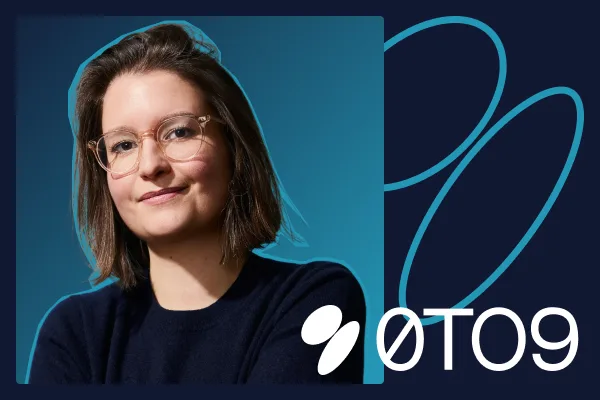
When IDnow launched the Trust Platform – a single-integration infrastructure for identity verification, fraud prevention, biometric authentication, and qualified digital trust – the very first customer to go live had every reason to go first. It was 0TO9, a credit institution and venture builder operating across multiple European markets, whose COO Germany and Partner Delia D. König had spent a decade working with IDnow across previous roles and had brought that relationship with her when she joined 0TO9. “Simple on the surface, powerful underneath.” 0TO9 on Going First with IDnow’s Trust Platform
Delia put it simply: “I’ve been working with IDnow for about ten years, so honestly, going for the Trust Platform was a no-brainer.
You build that kind of trust over time, and it’s not just about the product, it’s also about the people.”
The use of the word ‘no-brainer’ is telling and is the kind of language you only use when the answer was obvious before the question was finished. It also tells you something important, not just about 0TO9’s relationship with IDnow, but about the moment European fintech finds itself in right now.
The Architecture Problem Nobody Talks About
0TO9 is not a simple business. It operates multiple financial products across several European countries, each with its own regulatory requirements, its own risk profile and its own verification logic. The identity infrastructure underneath that business has to be capable of handling all of it simultaneously, compliantly, and without becoming an engineering project every time something changes.
That is a harder problem than it sounds.
The default solution in European fintech has been fragmentation: an identity vendor here, a fraud tool there, a separate integration for each new market, a compliance layer bolted on when the regulator requires it. It works until the engineering overhead becomes its own constraint, or until a new market means a new integration and a regulatory change means a re-integration project.
0TO9 knew this trajectory. They were living it.
“Without the Trust Platform, expanding would have meant more engineering work, higher costs, and longer timelines to go live,” Delia explains. “Now those barriers are just lower. It’s less about what’s possible and more about how quickly and efficiently we can actually do it.”
That shift – from possible to efficient – is the real value proposition of a unified identity platform. It doesn’t unlock markets that were previously unreachable, but it changes the cost and speed of reaching them. In a competitive European fintech landscape, that difference is everything.
One API. All the Use Cases.
The Trust Platform’s central promise is deceptively simple: one API integration that covers the full identity lifecycle – onboarding, authentication, fraud prevention, digital signing – across markets, regulations, and risk profiles. A visual workflow builder that lets compliance and product teams configure and adapt verification flows without pulling in engineering. Real-time decisioning built in. eIDAS 2.0, AMLR, and EUDI Wallet compliance built in.
For 0TO9, the proof was in the practice.
“What’s particularly valuable for us is the flexibility to not just configure but also customise and brand our flows,” says Delia. “We operate multiple products across several European countries, each with its own requirements. The fact that we can adapt those setups without pulling in engineering every time is genuinely significant. One API, all the use cases. That simplicity is what makes the platform work at our pace.“
She describes the platform’s appeal in a phrase that captures something the industry often misses: “Simple on the surface, powerful underneath.”
That combination of genuine simplicity at the interface layer and the genuine capability underneath is harder to achieve than it looks. Most platforms offer one or the other. The engineering complexity gets pushed somewhere: either into the platform’s own abstraction layer, making it inflexible, or into the customer’s integration, making it expensive. The Trust Platform’s architecture is built to absorb that complexity without passing it on.
For a business like 0TO9, operating at pace across multiple markets, that abstraction is not a nice-to-have. It is the infrastructure that makes growth possible without growth becoming a compliance liability.
The Regulatory Clock is Ticking. For Everyone.
The timing of the Trust Platform’s launch is not incidental. AMLR enforcement lands July 2027, with mandatory EUDI Wallet acceptance following in November. Every regulated business in Europe is on the same countdown, but not every business is equally prepared.
For 0TO9, the regulatory outlook isn’t an abstract future risk, but a present operational reality that shapes how they think about every infrastructure decision they make today.
“Europe’s regulatory environment is moving fast, and you need infrastructure that can move with it,” Delia says. “One of the things that gave us confidence in the Trust Platform is knowing we’re not navigating that alone. IDnow is deeply embedded in these developments, and we’re building our compliance posture alongside them.”
That last phrase, building our compliance posture alongside them, is worth pausing on.
The conventional model of vendor relationships in identity infrastructure is transactional: a vendor provides a service, a customer consumes it, and both parties manage their own regulatory exposure. What Delia is describing is a partnership where the vendor’s position in the regulatory landscape actively strengthens the customer’s compliance posture.
IDnow’s Trust Platform is built for exactly that dynamic with its in-house Qualified Trust Service Provider, IDnow Trust Services AB, certified with zero non-conformities and on track to be among the first listed on the EU Trust List for QEAA issuance. In addition, the platform has active EUDI Wallet Relying Party capability already operational in key markets, which means the platform isn’t just compliant with the regulations coming in 2027, but has been built around them.
For 0TO9, that means the compliance complexity of the next 18 months becomes a platform update rather than a re-integration project.
What Trust Actually Means
Compliance doesn’t have to be navigated alone. That sounds simple, but in practice, for most regulated businesses managing fragmented vendor relationships across shifting regulatory frameworks, it rarely works that way.
Delia puts it plainly. “I’m excited about growing into those new regulatory regimes together with IDnow rather than having to navigate them alone.”
Together rather than alone, and that distinction sits at the heart of what the shift from KYC to TYC actually means in practice. Know Your Customer was always a solitary exercise – verify, record, move on – but Trust Your Customer is something different. It’s continuous, it’s mutual, and it gets stronger the longer it runs. It is not a one-time check, but a relationship that compounds.
The best partnerships work the same way.
What Comes Next
As 0TO9 continues to expand with new subsidiaries, new products and new markets across Europe, the infrastructure question doesn’t go away, it just changes shape.
“As we launch more subsidiaries and products across the continent, having a platform that scales with us – without requiring a new integration every time – is exactly what we need,” Delia says. “The foundation is there. Now it’s about building on it.”
Building on it – not rebuilding, re-integrating, or re-procuring it.
That is the difference between a vendor and a platform, and it is the difference between compliance as a cost centre and compliance as a foundation for growth.
The countdown to 2027 is the same for everyone. The readiness isn’t.
0TO9 already knows which side of that line they’re on.
The IDnow Trust Platform is live now. One integration. Identity verification, fraud prevention, biometric authentication, and qualified digital trust – built for where European regulation is going.
By

Nikita Rybova
Customer & Product Marketing Manager

Ellie Burns
Marketing Director