



Table of Contents
Ready to partner with IDnow?
Turn faces into trusted identities.
European banks have until December 2027 to accept EUDI Wallets. Here’s everything they need to do to ensure they’re ready for the deadline.
In the previous entry in our ‘Everything You Need to Know About EUDI Wallet’ series, ‘European Digital Identity Wallet Readiness: A Country-by-Country Assessment’, we explored how each EU member state was faring in its launch journey and discovered significant differences in how prepared they were.
Thankfully, though, the EUDI Wallet isn’t being rolled out cold and in fact, since 2023, a series of European Commission-funded Large-Scale Pilot (LSP) projects have been testing wallet technology in real-world conditions across member states, building the evidence necessary for successful deployment. IDnow is proud to be a member of many of these initiatives, including the three below.
The Large-Scale Pilots Shaping How EUDI Wallets Will Work in Practice.
APTITUDE
The Advanced Project for Trusted Identity Technologies and Unified Digital Ecosystem (APTITUDE), coordinated by France’s National Agency for Secure Documents (France Titres), launched in October 2025 with a kick-off event in Paris attended by over 300 representatives. Funded jointly by the EU’s Digital Europe Programme and national co-funding, APTITUDE brings together 117 public and private partners across 11 EU member states, and Ukraine.
We Build
The We Build Consortium is a large-scale pilot focused on building the technical and governance foundations for EUDI Wallet issuance and acceptance across member states. We Build focuses on digital government services and provides infrastructure insights on how Personal Identifiable Data should be issued and verified. Its outputs are feeding directly into the EU Digital Identity Wallet Architecture and Reference Framework (ARF), and the implementing acts that banks will need to comply with.
Wallet Forum
The Wallet Forum serves as the cross-project collaboration and knowledge-sharing hub for all LSPs. It provides a structured environment for member states, pilot consortia, technical experts, and the European Commission to align on standards, share findings, and resolve implementation challenges. For any organisation tracking EUDI Wallet developments, the Wallet Forum is an essential reference point — and a signal of how seriously the Commission is treating coordination across this initiative.
Together, these projects represent Europe’s largest coordinated investment in digital identity infrastructure. The lessons learned from each pilot are directly informing the technical specifications, governance frameworks, and acceptance protocols that will govern EUDI Wallet use in financial services.
“From our direct involvement in the LSP pilots defining how wallets will work in practice, to our contributions to the ETSI and CEN standards that underpin them, IDnow brings everything a bank needs to bridge the gap between where identity verification is today and where it’s going tomorrow.”
Liudmyla Rabchynska, Director of Global Regulatory and Government Affairs at IDnow.
The 4 Operational Challenges Banks Cannot Ignore.
In theory, every EUDI Wallet follows the same ARF. In practice, however, 27 member states mean 27 variations — different trust registries, different PID schemas, and different attestation types. As such, banks will need to validate credentials from any EU Wallet, in real time, regardless of which country it was issued. That demands a relying party infrastructure built for flexibility, not just compliance. Other challenges include:
Trust Registry Navigation
To verify a wallet credential, a bank must be able to check it against the issuing state’s trust registry (a national list of authorised wallet issuers and trust service providers). Although each member state maintains its own registry, the Commission has announced that it is developing a cross-European trust list.
AML and CDD Calibration
The EUDI Wallet provides a high level of assurance about identity — but it does not perform Customer Due Diligence (CDD). Banks must still determine which level of assurance is required for different transaction types, calibrate their risk engines accordingly, and ensure that wallet-based onboarding flows satisfy their own internal AML policies — as well as the formal requirements of the Anti-Money Laundering Regulation.
Legacy System Integration
Many European banks are running core banking systems that were not originally designed with digital wallet credentials in mind. Integrating EUDI Wallet acceptance into legacy onboarding flows, KYC databases, and CRM systems represents a significant IT investment. Banks that start this integration work late will face both compliance risk and competitive disadvantage.
Rollout Unevenness
As the above readiness section makes clear, wallet maturity will not be uniform across the EU at launch. Therefore, a bank that builds its 2027 compliance plan around the assumption that all member states will have fully functional, broadly adopted wallets by December 2026 is likely to be disappointed. Realistic planning requires a phased acceptance model that can accommodate both wallet and non-wallet customers for a transition period.
The EUDI Wallet Deadline Readiness Checklist: 10 Steps Before December 2027.
Banks and financial institutions acting as relying parties need to complete the following ahead of the December 2027 mandatory acceptance deadline:
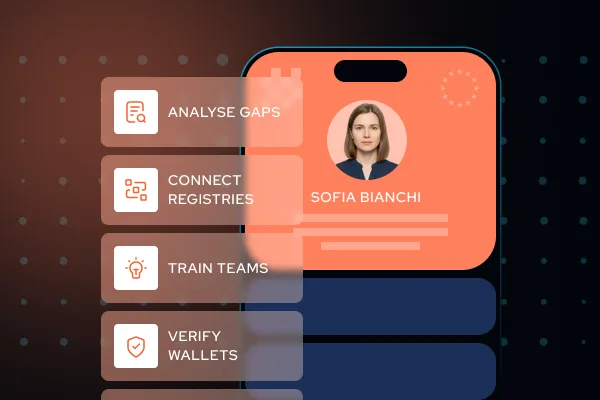
- Conduct a gap analysis: map existing identity verification and KYC flows against EUDI Wallet acceptance requirements.
- Appoint a cross-functional project team spanning compliance, technology, operations, and legal.
- Register as a relying party with relevant national competent authorities.
- Integrate ARF-compliant relying party software into onboarding and authentication flows.
- Connect to national trust registries — and monitor EU-level cross-border trust list development.
- Partner with an identity verification provider that is capable of handling EUDI Wallets, eID systems, and Qualified Trust Services.
- Update AML/CDD policies to reflect the assurance levels and data attributes available via EUDI Wallet credentials.
- Train compliance and operations teams on wallet-based identity: what it contains, how it’s verified, and how it fits into risk frameworks.
- Pilot wallet-based onboarding internally or with selected customer segments ahead of mandatory rollout.
- Engage with a specialist identity verification provider like IDnow to ensure technical and regulatory readiness.
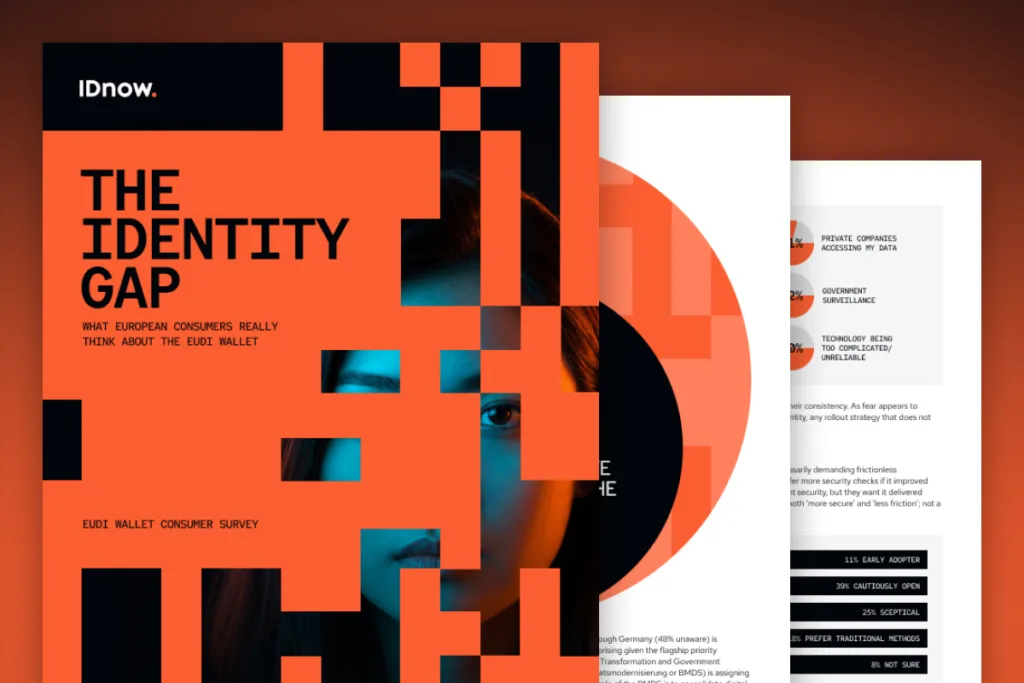
EUDI Wallet Consumer Survey
Download ‘The Identity Gap’ to discover what 2,000 European consumers really think about the EUDI Wallet, and what it means for banks, telcos, governments, and every organisation building their identity verification stack.
The Benefits of EUDI Wallets — For Banks and Their Customers.
It’s easy to see the EUDI Wallet as simply a series of compliance obligations, but the bigger picture is one of genuine opportunity. Banks that move early and build robust acceptance infrastructure stand to gain:
Faster, Lower-Cost Onboarding
Wallet-based PID can dramatically reduce the time and cost of customer onboarding. Eliminating manual document review, reducing re-verification touchpoints, and streamlining KYC processes translate directly into lower operational costs and faster customer acquisition.
The cost of friction is measurable: In our 2026 EUDI Wallet Consumer Survey, we found that nearly half (46%) of European consumers have abandoned a transaction because identity verification was too difficult or time-consuming. Wallet-based onboarding directly eliminates the friction points that drive that drop-off.
Fraud Reduction
Cryptographically authenticated government credentials are significantly harder to forge than physical documents or conventional digital credentials. Banks using wallet-based identity will benefit from a substantial reduction in identity fraud risk — one of the sector’s most costly challenges.
Cross-Border Customer Acquisition
The EUDI Wallet fundamentally lowers the barrier to serving customers from other EU member states. A harmonised, trusted identity standard means a bank in the Netherlands can onboard a Lithuanian customer with the same confidence as a domestic one — opening new markets with ease.
Enhanced Privacy and Customer Trust
Selective disclosure means customers share only what’s needed. This privacy-by-design approach is increasingly what consumers expect — and regulators demand. Banks that can offer wallet-based onboarding will be able to tell a compelling story to privacy-conscious customers.
Our 2026 EUDI Wallet survey data backs this up: 63% of European consumers say they are more likely to use the EUDI Wallet if it lets them share only what’s needed — rising to 74% among Gen Z and 70% among Millennials.
Future-proof Position Against Regulatory Change
Building EUDI Wallet acceptance now means building compliance infrastructure that is aligned with the direction of travel in EU regulation — AMLR, AML6D, PSD3, and beyond. Early movers won’t need to retrofit compliance into their systems under deadline pressure.
How IDnow Can Help
IDnow exists at the intersection of identity verification, regulatory compliance, and the European digital identity ecosystem. As both a technology provider and an active participant in shaping the frameworks that will govern the EUDI Wallet — through LSPS, through ETSI and CEN standardisation work, and through direct engagement with regulatory bodies across Europe — IDnow is uniquely positioned to help financial institutions enter the EUDI Wallet and AMLR era with ease.
The IDnow Trust Platform brings together market-leading fraud signals and the broadest set of identity verification methods on the market (including each of the three AMLR-recognised methods of identity verification), allowing organisations to meet eIDAS 2.0 and AMLR requirements out of the box, with a certified platform that regulators already trust. Plus, thanks to IDnow’s broad portfolio of verification methods, fallback flows ensure onboarding never stops, even when a wallet can’t be used.

Deploy Trust Your Way
National Electronic Identification (eID):
National electronic identification schemes already notified under the original eIDAS framework (e.g., Germany’s existing eID, France’s France Connect+) will continue to be valid under AMLR but operate at national rather than pan-European level.
Discover how the IDnow Trust Platform can seamlessly integrate eID Schemes into your workflows to deliver scalable, compliant onboarding.
EUDI Wallet:

EUDI Wallets are government-issued digital wallets that are compliant with eIDAS 2.0 and contain verified Person Identification Data (PID) and attestations. EUDI Wallets will be considered as the highest level of trust within the AMLR framework for digital identity.
Discover how the IDnow Trust Platform can bring EUDI Wallets into your onboarding flow with one integration, giving you verified, reusable digital identities at scale.
Qualified Trust Services:
Qualified Trust Services are services such as Qualified Electronic Signatures (QES) and Qualified Electronic Seals that issued by Qualified Trust Service Providers listed on national Trusted Lists. Such services are used in document signing and authentication processes and carry strong legal weight.
Discover more about our IDnow Qualified Trust Services.
Twenty-seven member states. Three accepted verification methods. One compliance deadline. And a financial services industry that needs to be ready for all of it. Don’t build from scratch. Partner with the team that’s already there.
This is the final blog in our three -part EUDI Wallet series. Missed the earlier instalments? Start from the beginning with Blog 1: ‘The EUDI Wallet Explained: What Banks Need to Know Before 2027’ — or speak to one of our experts about your institution’s EUDI Wallet readiness today.
About the author

Jody Houton
Senior PR & Content Manager at IDnow
Jody Houton is a B2B content marketer at IDnow, where he creates and edits engaging content about KYC, fraud and digital identity. He also oversees the company’s public relations.
Connect with Jody on LinkedIn