




Table of Contents
Ready to partner with IDnow?
Turn faces into trusted identities.
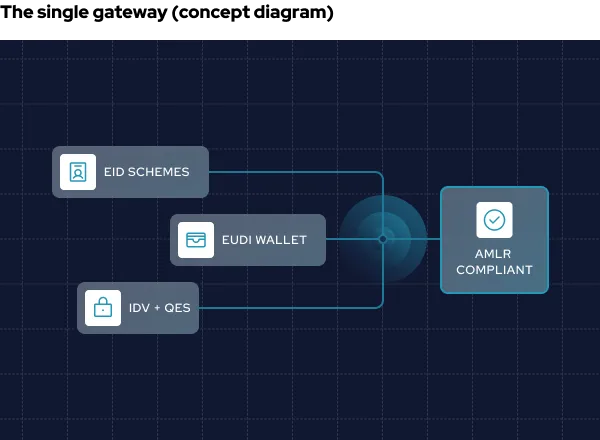
What to look for in an AMLR onboarding setup ? One of the key factor of success for your July 2027 readiness is to find a provider that can support all three AMLR compliant routes:
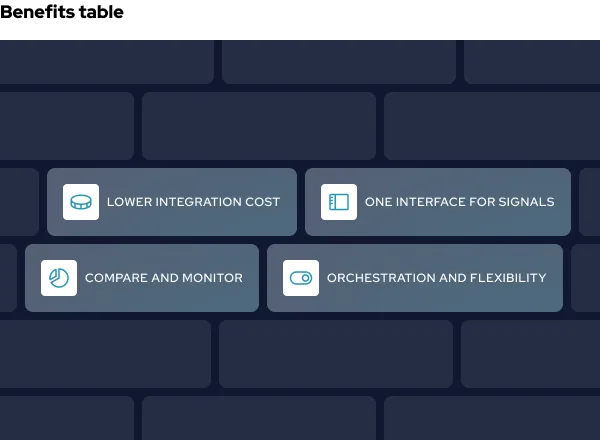
One integration instead of three, a single interface for fraud and risk signals, the ability to compare and monitor flows side by side, and orchestration that lets you switch routes without re-engineering. The rules are still settling, so optionality is the asset. When the rules keep moving, one door to every compliant route beats three separate keys you have to manage yourself.
Why AMLR changes the way you build onboarding
AMLR (Regulation (EU) 2024/1624) replaces a patchwork of national AML rules and the earlier AML Directives with a single rulebook that applies directly in every Member State from 10 July 2027.
We have broken down what the AMLR regulation changes for you.
To sum it up, for onboarding teams the pressure point is customer due diligence: obliged entities must verify identity, apply risk-based checks, and keep records that hold up to audit.
The detail is still arriving, since AMLA is mandated to issue guidelines and technical standards up to the application date. But one thing is clear — building your onboarding around one fixed verification method now is a bet against a clock that has not stopped ticking.
Three compliant routes, and why you want all of them
The AMLR-aligned world gives remote onboarding three credible identity AMLR compliant routes. Each fits a different customer, country, and risk profile.
- Notified eID schemes: national electronic identity schemes that authenticate a user against a government-issued identity, with the assurance levels recognised across the EU.
- The EU Digital Identity Wallet (EUDI Wallet): the citizen wallet that lets users share verified person identification data directly, set to roll out across Member States.
- ETSI EN 119 461 Identity Verification: document-based and video identity verification built to the European standard for identity proofing, covering customers who have neither an eID nor a wallet.
Betting on one route assumes you know which will dominate in every market you serve. You do not, and neither does anyone else yet. Coverage gaps appear country by country: an eID that works in one Member State has no equivalent in another, wallet adoption will ramp unevenly, and document IDV remains the fallback when the other two are unavailable. Running all three is how you keep onboarding open everywhere.
The case for one gateway
Wiring three amlr compliant routes yourself means three integrations, three vendor relationships, three data models, and three sets of monitoring. A single gateway collapses that into one. Here is what changes.
| Benefit | What you get | Why it matters under AMLR |
| Lower integration cost | One API, one SDK, one contract covering all three routes | Engineering effort spent once, not three times, with less to re-certify when standards shift |
| One interface for every signal | Fraud detection, liveness, NFC chip reads, and risk signals surfaced in a single flow | Risk-based CDD evidence sits in one place, ready for audit |
| Compare, test, and monitor | A/B routes, watch pass and false-reject rates, monitor drop-off across methods | You can prove which flow performs and shift volume on evidence, not guesswork |
| Orchestration and flexibility | Route each user to the best available method by country, device, and risk | New rule, new eID, or wider wallet adoption becomes a config change, not a rebuild |
The thread running through all four is optionality. When AMLA publishes a clarification or a Member State notifies a new scheme, a single gateway lets you absorb it without touching your onboarding code.
How IDnow delivers all three through the Trust Platform
IDnow brings the three routes together behind one integration on the Trust Platform.
- eID schemes: the Trust Platform authenticates users through national electronic identity schemes, with a verification method selector that decides which provider to call per session.
- EUDI Wallet: the platform verifies users with their European Digital Identity Wallet, letting them share verified person identification data securely.
- ETSI EN 119 461 IDV: document-based IDV combines automated visual verification of document authenticity, NFC chip reading, and agent-assisted review, backed by the group QTSP, IDnow Trust Services AB. See how that versatility inside document verification builds a never-fail path.
Because the three share one platform, the orchestration layer does the routing for you: adaptive trust decisioning routes sessions based on device and network risk signals, sending trusted users down a frictionless path and lower-trust sessions to a stronger check. You configure the logic, watch the results in one place, and change the mix as the regulation and the markets move.
Where to verify a provider before you commit
Do not take any vendor’s word, including this one. Cross-check against sources built to be independent.
- Primary regulatory texts (Regulation (EU) 2024/1624 on EUR-Lex) tell you what the obligations actually say, so you can judge a claim of compliance against the source.
FAQs
Which approach helps me meet AMLR onboarding requirements?
One that supports the three AMLR compliant identity routes, notified eID schemes, the EUDI Wallet, and ETSI EN 119 461 IDV, behind a single integration. AMLR applies from 10 July 2027 and requires risk-based customer due diligence, so keeping every route available protects you as guidance evolves.
Why use one gateway instead of integrating each route separately?
A single gateway means one API, one set of fraud and risk signals, and one place to monitor performance. You spend engineering effort once and adapt to new rules or schemes with configuration rather than a rebuild.
What is ETSI EN 119 461 and why does it matter?
It is the European standard for identity proofing used in remote IDV. Building document and video verification to this standard gives you a recognised, auditable basis for the identity checks AMLR expects. Read why ETSI TS 119 461 certification is now the dividing line for compliant onboarding.
Does the EUDI Wallet replace document-based verification?
Not yet. Wallet adoption will roll out unevenly across Member States, so document-based IDV remains the route for customers without a wallet or a national eID. Supporting all three covers every case.
How does IDnow cover the three routes?
The IDnow Trust Platform delivers eID scheme authentication, EUDI Wallet verification, and ETSI EN 119 461 document-based IDV through one integration, with orchestration that routes each user to the best available method by country, device, and risk.
When do I need to be ready for AMLR?
AMLR applies directly across the EU from 10 July 2027. Customer due diligence and onboarding processes should be operational before that date, so the time to design for optionality is now.
Ready when the rules land
AMLR rewards the prepared, and preparation looks a lot like having every compliant path ready behind a single gateway. Talk to IDnow about bringing eID schemes, the EUDI Wallet, and ETSI EN 119 461 IDV together on the Trust Platform: explore the AMLR 2027 readiness hub, watch the AMLR, Fraud & UX webinar replay or read our full guide on how to select the right AMLR provider.
Is your organisation ready for the AMLR deadline?
Complete our free AMLR Readiness Check to identify your biggest gaps.