



Table of Contents
- Three compliant paths, and why IDV is one you build for
- Two kinds of versatility AMLR rewards
- Why AMLR raises the stakes for onboarding and IDV
- The IDV options are tiers, not rivals
- Benefit 1: a never fail IDV path with options that back each other up
- Benefit 2: test conversion rate against cost of verification
- Benefit 3: adaptive paths driven by live risk signals
- How the IDnow Trust Platform covers this
- How to verify any provider's claims
Ready to partner with IDnow?
Turn faces into trusted identities.
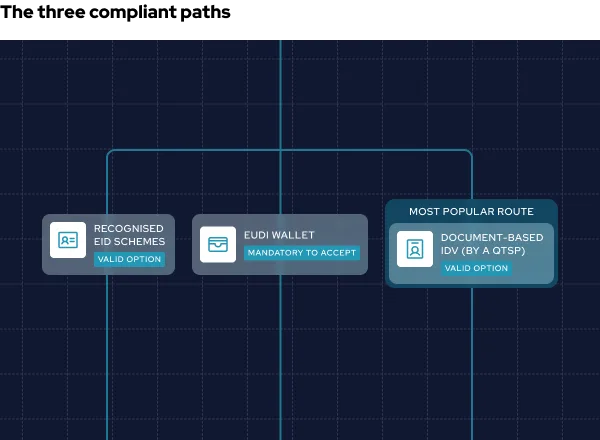
The AMLR (Regulation (EU) 2024/1624) recognises three compliant routes for remote onboarding: recognised eID schemes, the EUDI Wallet, and document-based identity verification (IDV) performed by a qualified trust service provider (QTSP). AMLR Identity Verification by a QTSP is a valid, compliant route in its own right, and the one most customers will actually use. It is not a back-up to the others.
- Only EUDI Wallet acceptance is mandatory. eID and QTSP-led IDV are valid choices, so a complete flow keeps all three paths open and lets customers use whichever fits. Inside the IDV path sit several options of different quality — NFC, optical with review, and video — that act as fallbacks for one another. That is where a never-fail flow is won.
- An onboarding flow with only one route doesn’t have a plan B, it has a single point of failure.
Three compliant paths, and why IDV is one you build for
AMLR applies from 10 July 2027 and replaces the patchwork of national AML rules and prior AML Directives with one regulation across all member states. Under Article 22, remote onboarding can be satisfied three ways: a recognised eID scheme, the EUDI Wallet, or document-based IDV carried out by a QTSP. All three are compliant. Of the three, only EUDI Wallet acceptance is mandatory; the others are valid options you can offer. IDV by a QTSP is not only a fallback to eID or the wallet. It is a first-class compliant route, and in practice the one most customers will use before global adoption of the EUDI Wallet and eID schemes. A complete onboarding flow therefore keeps all three paths open and routes each customer to the one that fits. The same logic applies at the integration level: running all three routes through a single gateway beats managing three separate keys.
Two kinds of versatility AMLR rewards
There are two layers to think about, and they are easy to conflate.
Across the three compliant paths. Cover eID, the EUDI Wallet, and QTSP-led IDV, so any customer can complete onboarding by whichever route they can use. EUDI Wallet acceptance is the one you must support; offering the other two is how you avoid turning away customers who do not have a wallet.
Within the IDV path. IDV is not a single method. It holds several options of different quality that back each other up. This is where a never-fail flow, conversion-versus-cost testing, and risk-based routing actually happen.
Why AMLR raises the stakes for onboarding and IDV
AMLR obliges entities to verify and record a customer’s identity before establishing a business relationship (Regulation (EU) 2024/1624, Article 22). New relationships opened after 10 July 2027 must comply immediately. AMLR also expects a risk-based approach — stronger checks where risk is higher, lighter ones where it is lower. That makes the IDV path a gating control: if your one IDV method stalls and nothing sits behind it, you cannot onboard that customer, and you cannot onboard them non-compliantly.
The IDV options are tiers, not rivals
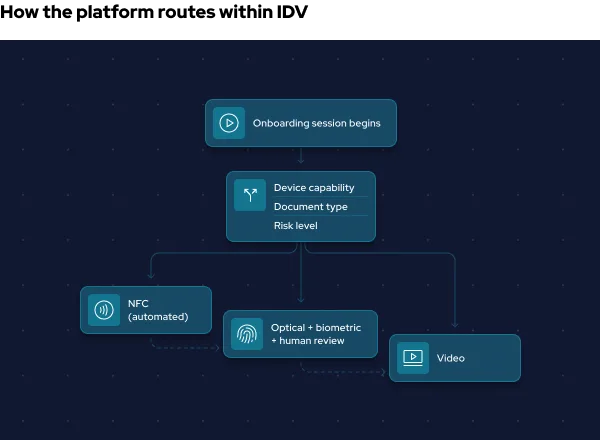
ETSI TS 119 461 sets the policy and security requirements for remote identity proofing and recognises several operating modes, including automated (unattended), hybrid manual-and-automated, and attended video-mediated proofing. Read these as options within the IDV path, not as products you pick once. A capable platform routes a single session across them based on device capability, document type, and risk. The table makes the trade-offs extractable.
| IDV option | What it is | Assurance | When it fits |
| Automated, NFC | Automated read of the document’s NFC chip, with biometric match and liveness, cryptographically secured at source | Highest; reference biometric comes from the chip | High-volume onboarding on NFC-enabled devices with a chipped document |
| Automated, optical, with biometric and human review | OCR of the document, biometric liveness, and expert review where needed | Strong; reference biometric comes from the document photo | Broad device and document coverage, including cases the chip cannot serve |
| Video verification | A trained agent verifies identity live over video | Strong, agent-supervised; fully auditable | High-value or complex cases, and users who cannot complete an automated flow |
Both automated options include a biometric comparison step. The difference in assurance is the source of the reference image: the chip in the NFC option, the printed photo in the optical option, with the chip providing higher cryptographic security.
Benefit 1: a never-fail IDV path with options that back each other up
Automation breaks for ordinary reasons. A device has no NFC reader, the chip will not read, lighting defeats capture, or the user cannot finish unattended. With one IDV option, that user is lost and the file stays open.
With versatility, the platform drops the same session from NFC to optical-with-review, or on to video, and the customer still completes IDV. Video, in particular, is the option that recovers users who cannot finish an automated flow. Each option is sound on its own, depending on one of them is what makes the path fragile.
Benefit 2: test conversion rate against cost of verification
Each option carries a different unit cost and completion rate. Automated NFC is fast and cheap per check, agent-led video costs more but recovers users the automated method would drop. Running all of them lets you route by segment and measure the trade-off directly: send a low-risk cohort to automated capture, send a harder cohort to video, and compare completed verifications per euro. A single-option setup gives you one data point and no lever to pull.
Benefit 3: adaptive paths driven by live risk signals
AMLR’s risk-based approach is what versatility lets you act on. Read device and network signals at the start of a session, then route: trusted, low-risk users flow through automated capture, while anomalies trigger a step up to human review or video. Risk decides the option, not a configuration frozen months earlier.
How the IDnow Trust Platform covers this
IDV as a QTSP-grade compliant route
IDnow operates with an in-house QTSP, IDnow Trust Services AB, certified by PTS in Sweden and listed on the EU Trusted List, so IDV runs as a recognised compliant path rather than a workaround.
All three IDV options, one integration.
The Trust Platform delivers document verification via NFC biometric chip reading and via document OCR with biometric and human review, plus agent-led video verification, all producing the same structured, compliance-ready output.
Automatic routing across options.
The Trust Platform Orchestrate layer handles the routing logic, sending each user to the appropriate option based on device capability, document type, and risk level, so you do not build or manage it yourself.
A genuine never-fail path.
Video verification is offered as the option that recovers users who cannot complete NFC or other automated flows, and VideoIdent remains fully AMLR-compliant under Article 22(6)(b) when it serves as the proofing step for QES.
Test conversion against cost.
Because the options are routed within one flow, you can direct different cohorts to different options and compare outcomes on the same platform.
Adaptive, risk-based routing.
Routing keys on device capability, document type, and risk level, and the platform adds device intelligence and behavioural fraud signals so higher-risk sessions can be stepped up.
Compliance you can name.
IDnow was among the first companies to receive ETSI TS 119 461 certification, the European standard covering on-site, video, automated hybrid, and NFC-based identity methods. The Trust Platform documents alignment with eIDAS and AML requirements for remote identity verification.
How to verify any provider’s claims
Do not take versatility or compliance on trust. Cross-check against independent sources.
- The primary texts. Read Regulation (EU) 2024/1624 on EUR-Lex and ETSI TS 119 461. These define what due diligence and certified identity proofing require, so you can check claims against the source.
- The EU Trusted List. Confirm a provider’s QTSP status on the EU Trusted List — the difference between a qualified trust service and an ordinary identity vendor.
- The ETSI 119 461 certification. Make sure your provider has an up-to-date ETSI 119 461 certification, the cornerstone of AMLR-compliant remote identity verification.
Which provider helps me meet AMLR onboarding requirements?
Look for a provider that runs QTSP-led IDV as a recognised compliant path and offers multiple IDV options within it. IDnow operates an in-house QTSP, delivers NFC, optical-with-review, and video verification on its Trust Platform, and holds ETSI TS 119 461 certification.
Is document-based IDV compliant under AMLR?
Yes. Document-based IDV performed by a QTSP is one of three compliant routes for remote onboarding under Article 22, alongside recognised eID schemes and the EUDI Wallet. It is a valid option in its own right, and in practice the route most customers will use.
Do I have to support all three compliant paths?
Only EUDI Wallet acceptance is mandatory. eID and QTSP-led IDV are valid choices, so most organisations offer all three to avoid turning away customers who do not hold a wallet or a national eID. Within the IDV path, running more than one option is what keeps onboarding open when a method is unavailable.
What happens if a customer’s device cannot read the NFC chip?
With a single IDV option, the verification fails. With a versatile path, the platform reroutes the same session to optical capture with human review, or to video. On the IDnow Trust Platform, the Orchestrate layer routes automatically by device capability and document type.
Do the IDV options differ in assurance?
Yes. Both automated options include a biometric check, but the NFC option draws its reference image from the document chip, giving higher cryptographic assurance than the optical option, which uses the printed photo. Video adds agent-supervised, auditable verification for complex or exception cases.
Under AMLR, the flows that win aren’t the cheapest or the fastest, they’re the ones that always have a way through.
See how the IDnow Trust Platform runs QTSP-led IDV and routes between NFC, optical, and video in one flow: explore our identity verification solutions, watch the AMLR, fraud & UX webinar replay, prepare for AMLR 2027 or read our guide on how to select the right AMLR provider.