




Table of Contents
Ready to partner with IDnow?
Turn faces into trusted identities.
IDnow’s EUDI Wallet Consumer Survey reveals almost half of French and German consumers have abandoned transactions because identity verification was too difficult.
Nearly half (46%) of European consumers have abandoned a transaction due to identity verification being too difficult or too time-consuming. Not because they changed their mind. Not because they found a better offer but because proving who they were was simply too hard.
That figure comes from our recently released EUDI Wallet Consumer Survey, which surveyed 2,000 consumers in France and Germany.
For banks, fintechs, insurers, and any regulated business that depends on converting prospects into customers, this is a major revenue problem as well as a compliance problem. And it is happening right now.
The EUDI Wallet, which will allow users to store digital IDs, share official documents, and sign files electronically across Europe, has the potential to make identity verification faster and more secure than ever before, but only if it addresses your customers current gripes with identity verification.
Understanding the business impact of the EUDI Wallet before the rollout in December 2026, and mandatory acceptance by regulated businesses in 2027 is therefore imperative.
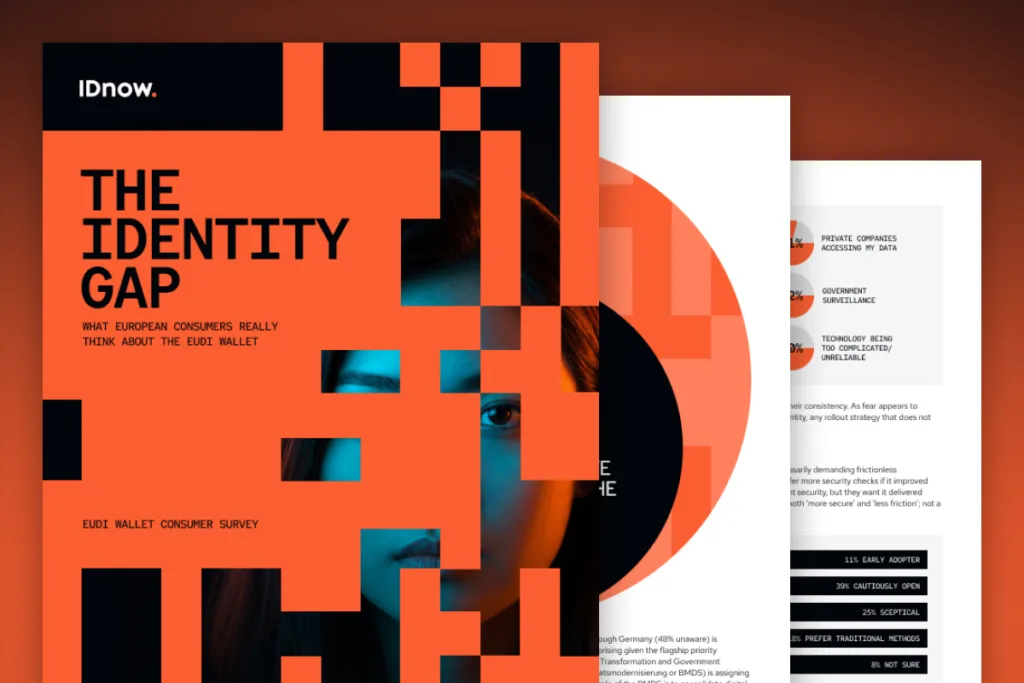
EUDI Wallet Consumer Survey
Download ‘The Identity Gap’ to discover what 2,000 European consumers really think about the EUDI Wallet, and what it means for banks, telcos, governments, and every organisation building their identity verification stack.
What’s Age Got to Do With it?
The 46% figure is striking on its own, but our research reveals some interesting differences between age groups.
Among Millennials (30–45), the abandonment rate rises to 54%, while for Gen Z consumers (18–29), it jumps to 56%. As these are the most digitally active and highest-lifetime-value customer segments in financial services, they are the most likely to give up when complicated or slow verification gets in the way.
The problem is consistent across markets (France: 45%, Germany: 48%) suggesting that drop-off rates aren’t related to a quirk or failing of one country’s digital infrastructure but something deeper and structural about how identity verification currently works in Europe.
“Every abandoned transaction is a customer who wanted to proceed but couldn’t. The EUDI Wallet, when integrated well, addresses the root cause of this conversion crisis: a verification process that asks for too much, takes too long, and must be repeated every time.”
Uwe Stelzig, Managing Director DACH, IDnow
Compliance vs Conversion: Why the Current Model is Broken.
The identity verification process most consumers encounter today was not necessarily designed with conversion in mind. It was designed for compliance and compliance alone. The result is a user experience that asks people to:
- Upload photographs of physical documents, often multiple times
- Submit a selfie, sometimes under specific lighting conditions
- Wait — sometimes minutes, sometimes longer — for manual review
- Repeat the entire process the next time they need something from a different provider
The inefficiency is baked into the architecture. Each organisation that needs to verify your identity has built — or bought — its own capability to do so in isolation. There is no shared infrastructure, no portable credential, no way for a bank to tell an insurer: “We already verified this person, to a recognised standard and here is the evidence.” Every organisation starts from scratch, every time.
The cumulative effect on consumers is significant. According to Juniper Research, there were 75 billion digital identity verification checks globally in 2024 — a 16% increase on the previous year. For the average adult navigating financial services, telecoms, travel, and public services, the repeated friction of identity verification has become one of the most consistent pain points in the digital economy.
Here’s How Your Customers Would Improve Identity Verification.
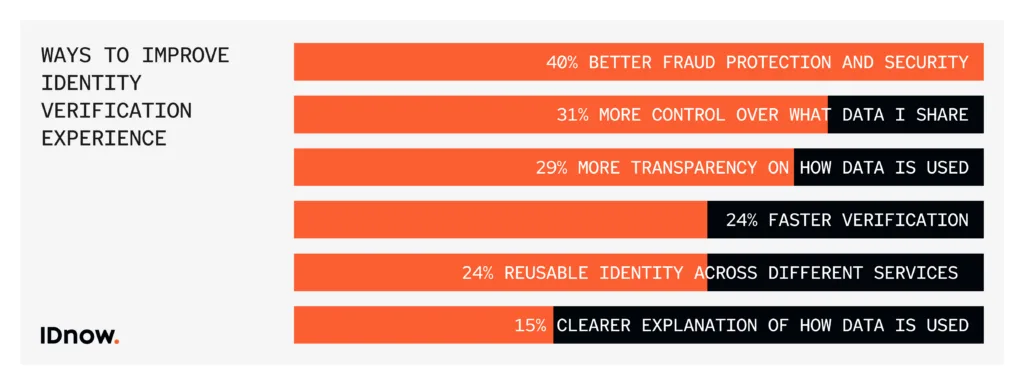
When we asked what would most improve their identity verification experience, the answers were unambiguous. Consumers want:
- Better fraud protection and security (40%)
- More control over their data (31%)
- Faster, simpler verification (29%)
- Reusable identity (27%)
- Fewer repeated checks across services (24%)
These are the precise capabilities the EUDI Wallet has been designed to deliver. Instead of uploading a passport every time a new service requires identity verification, a consumer presents a verified credential from their wallet. The receiving organisation verifies its authenticity cryptographically, in real time. There is no document upload, no manual review, no waiting. The check still happens; it just happens in the backend and is invisible to the user.
The current model asks every organisation to verify every person, every time, independently. The EUDI Wallet creates a shared foundation: verify once, to a recognised standard, by an authoritative source, and present that credential wherever it is needed.
For businesses, the implications are direct and immediate. Onboarding flows that currently lose nearly half of all prospects at the verification step become materially shorter. Drop-off rates fall and conversion improves.
The Friction Problem is Also a Trust Problem.
There is a second dimension to the abandonment data that deserves attention. The IDnow EUDI Wallet Consumer Survey Report discovered that the consumers most likely to abandon a transaction due to friction are also the consumers most likely to adopt the EUDI Wallet if they understand what it offers.
For example, 74% of Gen Z and Millennials said they would use the EUDI Wallet if it allowed them to share only the information required for a specific transaction, without revealing anything more, which is known as selective disclosure and is a key feature of the EUDI Wallet. The appetite is there. The infrastructure is arriving. The question is whether the institutions that serve these customers will be ready to meet them.
The data also reveals something important about the relationship between friction and trust. When asked whether they would prefer more security checks even if it meant a slower process, 47% of respondents said they would accept more friction in exchange for stronger security. This shows that consumers are not asking for less verification. They are asking for verification that does not feel like an obstacle. The distinction matters enormously for how financial institutions should think about their onboarding design.
With the IDnow Trust Platform, the friction disappears for the user, but the assurance does not. Rather than treating the EUDI Wallet as a replacement for verification, it treats the Wallet credential as one input into a broader, continuous identity assurance model that combineswallet-native onboarding with ongoing KYC, fraud signal analysis, and risk monitoring across the customer lifecycle. The friction disappears for the user. The assurance does not.
What the 46% Figure Means for Your Business Today.
The EUDI Wallet is often discussed alongside the compliance deadline — something to prepare for because the regulation requires it. That framing is accurate but incomplete.
The more immediate case for action is commercial. The 46% abandonment rate is not a future problem contingent on the EUDI Wallet’s rollout. It is happening today, in your current onboarding flows, with your current customers. Every week that verification friction persists is a week in which nearly half of the people who tried to become your customers decided not to.
The EUDI Wallet offers the most credible structural solution to the identity verification problem and the institutions that move earliest to integrate Wallet-native onboarding flows will have a measurable conversion advantage over those that treat it as a compliance checkbox.
“Member states and the institutions that serve their citizens have less than 18 months to move from awareness to readiness. The data shows that the communications work has barely begun.”
Liudmyla Rabchynska, Director of Global and Regulatory Affairs, IDnow.
FAQs about the EUDI Wallet
What is the EUDI Wallet?
The European Digital Identity (EUDI) Wallet is a government-issued digital wallet that allows EU citizens to store and present verified identity credentials — such as a national ID, driving licence, or proof of age — across borders and services without repeated verification. It is mandated under eIDAS 2.0, with member states required to issue wallets by December 2026 and regulated businesses required to accept them by November 2027.
What is the EUDI Wallet business impact for banks and fintechs?
The primary EUDI Wallet business impact for financial institutions is a material reduction in onboarding friction and customer abandonment. By replacing document uploads and manual review with cryptographically verified wallet credentials, banks and fintechs can shorten onboarding flows, reduce drop-off rates, and lower the cost of KYC compliance while maintaining full eIDAS 2.0 regulatory alignment.
Why do customers abandon identity verification?
According to IDnow’s 2026 consumer research, the most common reasons customers abandon identity verification include processes that take too long, require too many document uploads, and must be repeated with every new service provider. The abandonment rate is highest among Gen Z (56%) and Millennials (54%) — the most commercially valuable customer segments for financial services.
When is the EUDI Wallet mandatory?
EU member states must make the EUDI Wallet available to citizens by December 2026. Regulated businesses — including banks, payment institutions, telecoms providers, and insurers — must be capable of accepting EUDI Wallet credentials by November 2027.
How does the EUDI Wallet reduce onboarding friction?
Rather than requiring each organisation to independently verify a customer’s identity from scratch, the EUDI Wallet allows consumers to present a pre-verified credential issued by a trusted authority. The receiving organisation verifies its authenticity in real time with no document upload, no manual review, and no waiting. For businesses, this means shorter onboarding flows, lower drop-off rates, and a compliance posture that can be inherited from the credential issuer rather than rebuilt independently.
This is the first blog in our ‘The Identity Gap’ series. Next up: ‘Privacy vs Compliance. Why Selective Disclosure Is the EUDI Wallet’s Most Powerful Feature’.
By

Jody Houton
Senior PR & Content Manager at IDnow
Connect with Jody on LinkedIn