



Table of Contents
- Key Takeaways
- Why This Time It's Different with the EU AMLR 2027
- The Three Forces Behind AMLR 2027 Converging at Once
- The Uncomfortable Truth About Fragmented Stacks
- Not Every Bank Starts From Zero
- From KYC to TYC: A Different Way of Thinking About Trust
- What the Next 18 Months Require
- The Window Is Open. It Will Not Stay That Way.
- Where IDnow Fits to Help You Meet AMLR 2027 Compliance Requirements
- EU AMLR FAQs
Ready to partner with IDnow?
Turn faces into trusted identities.
AMLR lands in July 2027. Mandatory EUDI Wallet acceptance follows in November. Two deadlines. One fixed timetable. And an identity infrastructure landscape that most regulated businesses are not ready for.
Key Takeaways
- AMLR enforcement begins July 2027: No transposition period, no grace period, one standard across all 27 EU Member States simultaneously
- EUDI Wallet acceptance is mandatory from November 2027: A legal baseline, not a competitive differentiator
- AMLR changes the architecture, not just the rules: Ongoing monitoring, tamper-evident audit trails, and Qualified Trust Services are now structural requirements
- Fraud doesn’t just happen at onboarding: Synthetic identities, deepfakes, and account takeover exploit the gap between verification and the lifetime of the relationship
- Fragmented identity stacks are a liability, not just an inefficiency: Broken audit trails, integration complexity, and re-engineering costs every time regulation moves
- EUDI Wallets increase compliance complexity, not reduce it: More standards, more schemes, more edge cases, all evolving simultaneously
- Enterprise institutions don’t need to rip and replace:The IDnow Trust Platform works as a full infrastructure or module by module, even one verification method at a time
- KYC is a checkpoint. TYC is a relationship: Continuous, evidence-based trust across every interaction, not just the door
- The time to act is now, not 2027: EUDI Wallet certificates, QTSP relationships, and infrastructure decisions all require significant lead time
- Organisations that consolidate now enter 2027 with a structural advantage that latecomers will find very hard to close
There is a clock on the wall of every compliance team in Europe right now. Most people haven’t looked at it yet. Some have glanced at it and looked away. A few are already building.
The hands are moving regardless.
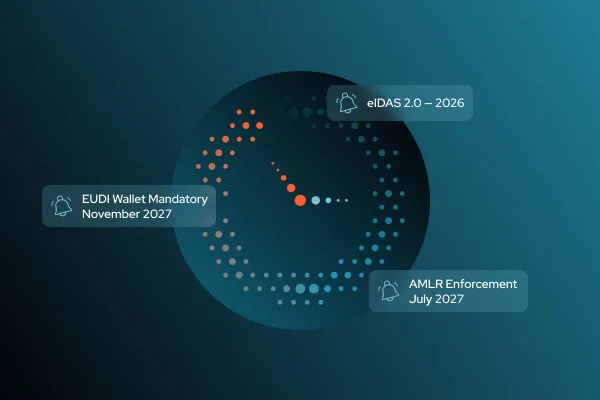
By July 2027, the Anti-Money Laundering Regulation (AMLR) replaces the patchwork of 27 national AML frameworks with a single, directly applicable EU standard. No transposition, no national interpretation, no grace period for the unprepared. Four months later, in November 2027, banks and regulated platforms across all 27 Member States must be capable of accepting EU Digital Identity Wallets. Not as an option. As a legal requirement.
That is 13 months from today.
This is not a compliance deadline in the ordinary sense, the kind that gets absorbed into an existing process with a policy update and a training module. This is a structural reset of how digital identity works across Europe. And for organisations still running fragmented, point-solution identity stacks, the clock is ticking on a problem that cannot be solved at the last minute.
Why This Time It’s Different with the EU AMLR 2027
European regulatory updates have a familiar rhythm. A directive is issued. Member States transpose it at varying speeds. Businesses adapt their processes. Compliance teams update their documentation and life goes on.
The AMLR regulations break that rhythm in three ways.
It is directly applicable. AMLR is a Regulation, not a Directive. It does not need to be transposed into national law. It applies directly, simultaneously, across all 27 Member States from the moment of enforcement. There is no Germany version and no France version, only one standard for all.
It changes the architecture, not just the rules. AMLR doesn’t just raise the bar on what counts as compliant customer due diligence, it changes how that due diligence must be structured, evidenced, and maintained over time. Ongoing monitoring is no longer optional and a complete, verifiable audit trail is not a nice-to-have. The one-time onboarding check that has anchored identity verification for a decade is no longer a sufficient operating model.
The EUDI Wallet deadline is mandatory, not voluntary. From November 2027, regulated businesses must accept EU Digital Identity Wallet presentations. Not if they want to and not as a competitive differentiator. As a legal baseline. France and Germany already have active public wallet sandboxes. Nineteen further Member States are in active deployment. The infrastructure is being built. The question is whether your organisation will be ready to receive it.
The Three Forces Behind AMLR 2027 Converging at Once
What makes the next 18 months genuinely unprecedented is not any single regulatory change. It is the convergence of three forces — simultaneously — on an identity landscape that was never designed to handle all three at once.
1. Regulation Is Resetting the Floor
AMLR and eIDAS 2.0 are not raising the compliance bar. They are moving the floor. The minimum viable compliance posture in 2028 will look fundamentally different from the minimum viable compliance posture today. Organisations that plan for incremental adaptation will find themselves structurally non-compliant — not through negligence, but because their operating model was built for a regulatory environment that no longer exists.
The specific implications are significant:
- Ongoing due diligence must be embedded into the customer lifecycle, not bolted on as a periodic review
- Qualified Trust Services — including Qualified Electronic Signatures and Qualified Electronic Attestations of Attributes — become the legal anchor for non-face-to-face verification under AMLR Art. 22(6)(b)
- EUDI Wallet acceptance requires Relying Party Access Certificates that take time to obtain and infrastructure that takes time to build
- Audit trails must be complete, tamper-evident, and long-lived — covering not just onboarding, but every subsequent identity-related decision
None of these can be implemented in a sprint. They require infrastructure decisions made now.
2. Fraud Has Industrialised
While regulators have been rewriting the rulebook, fraudsters have been rewriting theirs.
Generative AI has fundamentally changed the economics of identity fraud. Synthetic identities — combinations of real and fabricated attributes that defeat traditional document checks — can now be manufactured at scale. Deepfake attacks that would have required significant technical expertise two years ago are now available as a service on darknet forums. Injection attacks that insert fabricated video feeds into verification sessions are documented, prevalent, and evolving faster than static defences were designed to handle.
The more uncomfortable truth is where most fraud actually happens: not at onboarding, but after it. The identity check at the front door is passed. The account is opened. And then — days, weeks, or months later — the fraudulent activity begins. Account takeover. Authorised push payment fraud. Synthetic identity exploitation. None of these are caught by a one-time verification event.
The fraud problem of 2027 is a lifecycle problem. Solving it requires intelligence that travels with the customer across every interaction — not a check that stops at the door.
3. Customers Will Not Accept the Friction Tax
Here is the tension that every regulated business is navigating: the same period that demands the highest compliance standards in European history is also the period of the highest consumer expectations for digital experience.
Customers expect to be onboarded in seconds, not minutes. They expect to be recognised when they return without passwords or one-time codes. They expect verification to be invisible when they are legitimate and present only when something is actually wrong.
The assumption that compliance and experience are inherently in tension is wrong — but only if the underlying infrastructure is built to handle both simultaneously. A fragmented stack, with separate verification, fraud, authentication, and signing vendors that do not share signals or speak a common language, cannot deliver both. It can deliver compliance at the cost of experience, or experience at the cost of compliance. Rarely both.
The organisations that will win in the post-2027 environment are those that have stopped treating these as competing objectives.
Is your organisation ready for the AMLR deadline?
Complete our free AMLR Readiness Check to identify your biggest gaps.
The Uncomfortable Truth About Fragmented Stacks
Most regulated businesses today are running identity through a collection of point solutions. An IDV vendor for onboarding. A fraud platform for transaction monitoring. An authentication layer for returning users. A separate QTSP relationship for digital signatures. Sometimes a fourth or fifth vendor for specific regional requirements or document types.
Each of these was probably the right decision when it was made. Together, they have created something fragile.
Consider what happens when AMLR enforcement begins. Your compliance team needs to demonstrate a complete, connected audit trail – from the identity established at onboarding, through every authentication event, through every fraud signal detected, through every document signed. In a fragmented stack, that evidence lives in five different systems, maintained by five different vendors, in five different formats. Assembling it for an audit is a project, not a query.
Consider what happens when EUDI Wallets arrive at scale. Your onboarding flow receives a wallet presentation. Your IDV vendor may or may not support it. The wallet data needs to be validated for fraud. Some mandatory AMLR attributes – residential address, tax identification number – may not be in the wallet’s Personalisation Identity Data at all. You need a Qualified Electronic Attestation of Attributes to fill that gap. Do you have a QTSP relationship for that? Is that QTSP the same vendor as your IDV provider? If not, how do those systems connect?
Now consider what happens when AMLR changes something six months after enforcement begins. In a fragmented stack, a regulatory change becomes a re-integration project across every vendor in the chain. In a unified platform, it becomes a configuration update.
The organisations that are building on unified identity infrastructure now will absorb these changes as platform updates. Those that aren’t will face the most complex re-integration cycle in European identity history against live regulatory deadlines.
Not Every Bank Starts From Zero
Here is the reality that a purely “rip and replace” narrative misses: large regulated institutions. Tier-one banks, established insurance firms and pan-European financial groups rarely have the luxury of rebuilding their identity infrastructure from the ground up. They have existing vendor relationships, live integrations, regulatory approvals already in place, and internal systems that took years to build and cannot be switched off overnight.
The answer to fragmentation is not always consolidation in a single move. Sometimes it is consolidation by design – starting where the pain is greatest and building toward a unified architecture over time.
The Modular Path to a Unified Platform
The IDnow Trust Platform is built for both realities. For organisations ready to make a clean transition, it operates as a single, fully integrated infrastructure with one API, one audit trail, one vendor relationship covering the entire identity lifecycle. For enterprise institutions that need to move progressively, it works differently: each capability of the Trust Platform – identity verification, fraud prevention, biometric authentication, qualified trust services – can be deployed as a standalone module, integrating with existing systems and expanding over time.
But the modularity goes further than that.
Even within a single capability, organisations do not have to take everything at once. Take identity verification. Rather than adopting the full suite of verification methods — document checks, biometric verification, video identification, eID — an organisation can start with a single method that addresses their most pressing need right now. A bank preparing for the November 2027 EUDI Wallet mandate, for example, could deploy EUDI Wallet acceptance as a standalone method through the Trust Platform, plugging it into their existing onboarding flow without replacing a single other component. As wallet adoption grows and the regulatory requirement becomes operationally significant, they already have the infrastructure in place and adding further verification methods alongside it becomes a configuration decision, not an integration project.
An enterprise bank might start with IDnow’s fraud prevention layer, sitting on top of their existing IDV infrastructure. A fintech scaling across markets might begin with the verification orchestration engine, adding authentication and qualified signing as they grow. A regulated platform racing toward the AMLR deadline might prioritise qualified trust services first, adding EUDI Wallet acceptance alongside it.
The destination is the same in every case: a unified identity infrastructure where every component shares signals, speaks a common language, and produces a single, coherent audit trail. The path to that destination is entirely flexible.
This matters for enterprise banking specifically. The compliance clock does not care about internal transformation timelines or legacy integration constraints. But the right platform architecture means organisations do not have to choose between moving fast and moving carefully. They can do both, deploying the capabilities they need now, against the deadlines that are live now, while building toward the unified infrastructure that the post-2027 environment will demand.
Fragmentation is not solved in a single procurement decision. It is solved by choosing a platform that can meet you where you are and take you where you need to go.
From KYC to TYC: A Different Way of Thinking About Trust
The mental model that underpins most identity stacks – Know Your Customer – was designed for a specific moment: the onboarding event. Verify the customer, create a record, move on.
That model is reaching the end of its useful life.
The regulatory environment now requires something closer to what we call Trust Your Customer – continuous, evidence-based trust that is established at onboarding and maintained across every subsequent interaction. Not a check, a relationship. Not a record, a living audit trail.
This is not just a philosophical shift. It has direct operational implications:
- Authentication must be tied back to the identity established at onboarding, not a separate credential that could belong to anyone
- Fraud signals from the onboarding stage must inform risk assessment at authentication and beyond
- Compliance decisions at one point in the lifecycle must be traceable to evidence gathered at every previous point
- When regulations change, the trust established under the old framework must remain valid under the new one
Building for continuous trust requires infrastructure, not a collection of products. It requires components that share signals, speak a common language, and operate as a system – not as a sequence of independent handoffs.
What the Next 18 Months Require
The clock is not waiting for annual planning cycles or procurement timelines. Here is what the next 18 months actually demand from regulated businesses across Europe.
Now: Strategic decision: The organisations that will be ready by July 2027 are making infrastructure decisions today. The question is not “what do we need to do before the deadline?” but “what operating model do we want to be running in 2028 and what do we need to build now to get there?”
By end of 2026: Foundations: EUDI Wallet Relying Party Access Certificates, including the German Berechtigungszertifikat for organisations operating in Germany, take time to obtain. QTSP relationships, especially for Qualified Electronic Attestations of Attributes, require certified providers. These are not last-minute additions, but foundational dependencies.
Q1 2027: Readiness testing: AMLR enforcement begins in July. Organisations need to be in testing and validation well before that date – not still in procurement. The compliance clock does not offer a soft launch.
July 2027: AMLR enforcement: The new standard applies. The audit trail requirements are live. The qualified trust service route for non-face-to-face verification is mandatory. Fragmented stacks meet their first real test.
November 2027: EUDI Wallet acceptance mandatory: Banks and regulated platforms must accept wallet presentations. The infrastructure to receive them, validate them, enrich them, and deliver a compliance-ready result must be operational.
The Window Is Open. It Will Not Stay That Way.
There is an opportunity in the next 18 months that will not exist in the same form after 2027. The organisations that consolidate their identity infrastructure now – before the deadlines, not in response to them – will enter the new regulatory era with a structural advantage that is genuinely difficult for laggards to close.
They will onboard faster. They will detect more fraud, earlier, across more of the customer lifecycle. They will satisfy auditors with a single, coherent audit trail rather than a patchwork of vendor exports. They will absorb future regulatory changes as platform updates rather than re-integration projects. And they will do all of this while delivering the seamless digital experiences that their customers now expect as a baseline.
The countdown is the same for everyone.
The readiness isn’t.
Where IDnow Fits to Help You Meet AMLR 2027 Compliance Requirements
The IDnow Trust Platform is built precisely for this moment. It powers continuous identity orchestration across the full customer lifecycle and combines identity verification across every method and assurance level, real-time cross-step fraud prevention, biometric authentication tied to the original KYC identity, and in-house Qualified Trust Services through IDnow Trust Services AB, our own QTSP certified by PTS Sweden and listed on the EU Trusted List.
It accepts EUDI Wallets today in France and Germany, with 19 further Member States in active deployment. The Platform also enriches wallet presentations with fraud checks and attribute validation before delivering a compliance-ready result. For attributes not available in wallet Personalisation Identity Data, IDnow Trust Services AB issues Qualified Electronic Attestations of Attributes, completing the compliance picture that wallets alone cannot deliver.
One platform. One integration. One audit trail. Built for the regulatory environment Europe is entering – not the one it is leaving.
Ready to assess where your identity stack stands against the 2027 deadlines?
Schedule a readiness assessment with an IDnow expert
By

Andreas Bodczek
CEO, IDnow
EU AMLR FAQs
When does AMLR come into force?
AMLR enforcement begins 10 July 2027. There is no transposition period, no national interpretation, and no grace period. For regulated businesses, the deadline is fixed and applies equally across all 27 EU Member States on the same date.
Why is EU AMLR 2027 replacing the Money Laundering Directive?
The existing AML Directive framework produced 27 different national interpretations of the same rules — creating inconsistencies, regulatory arbitrage, and compliance gaps across the EU. AMLR replaces this fragmented approach with one directly applicable standard, closing the loopholes that financial criminals have historically exploited by operating across borders.
Who does AMLR 2027 apply to?
AMLR applies to obliged entities across the EU — including banks, fintechs, crypto asset service providers, insurance firms, payment institutions, and other regulated financial businesses. It also introduces new obligations for crypto asset service providers and strengthens requirements around beneficial ownership transparency.
How will onboarding and AML operations change with AMLR 2027?
Significantly. The one-time onboarding check is no longer a sufficient compliance model. AMLR mandates ongoing customer due diligence embedded throughout the customer lifecycle, tamper-evident audit trails covering every identity-related decision, and Qualified Trust Services as the legal anchor for non-face-to-face verification under Art. 22(6)(b). From November 2027, regulated businesses must also accept EU Digital Identity Wallet presentations as a legal baseline. The architecture of identity compliance changes — not just the rules.
How can compliance teams prepare for the EU AML Regulation?
The organisations that will be ready by July 2027 are making infrastructure decisions now — not in 2027. Specifically:
Now: Assess your identity stack against the new requirements — ongoing monitoring, audit trail completeness, QTSP relationships and consult our guide on choosing the right AMLR provider.
By end of 2026: Secure EUDI Wallet Relying Party Access Certificates and establish Qualified Trust Service provider relationships — both require significant lead time
Q1 2027: Be in testing and validation, not still in procurement
July 2027: AMLR enforcement is live — fragmented stacks meet their first real test
Organisations still running fragmented point solutions face the most complex re-integration cycle in European identity history against live regulatory deadlines. Those that consolidate onto a unified platform now will absorb these changes as configuration updates — and enter the post-2027 era with a structural advantage that latecomers will find very hard to close.