



Table of Contents
Ready to partner with IDnow?
Turn faces into trusted identities.
Which EU member states are ready for European Digital Identity Wallets? Not all will make the December 2026 deadline. Find out how your country stacks up and how IDnow can help now.
In the first blog in our ‘Everything You Need to Know About EUDI Wallet’ series, we covered the fundamentals of the EUDI Wallet — what it is, what it contains, and why the 2027 deadline represents a pivotal moment for every bank in Europe.
Now, with the framework explained, the next logical question is whether the infrastructure will be complete in time. So, with the December 2026 deadline fast approaching, let us look at how ready member states are, as of early 2026, starting with two of Europe’s most influential and economically powerful nations, France and Germany.
EUDI Wallet Consumer Survey
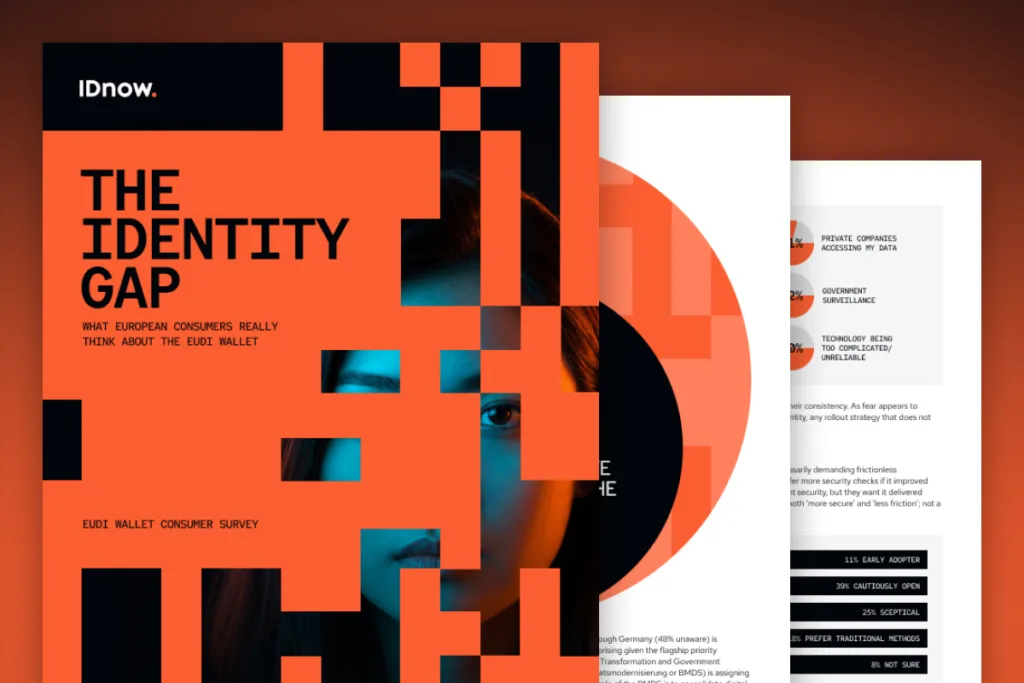
Download ‘The Identity Gap’ to discover what 2,000 European consumers really think about the EUDI Wallet, and what it means for banks, telcos, governments, and every organisation building their identity verification stack.
Germany: Advanced Infrastructure, Complex Implementation.
Germany entered 2026 with one of the most sophisticated pre-existing digital identity infrastructures in Europe. The German eID system — embedded in all German national ID cards and passports since 2010 — has a ‘High’ assurance level, according to eIDAS. The German government has been an active participant in the ARF development process and has publicly committed to meeting the 2026 deadline.
The German EUDI Wallet Hackathon takes place on 4–5 June 2026, open to developers, designers, product managers, and public sector participants, with top teams presenting at the EUDI Wallet Community Event in Berlin on 25 June.
For banks, due to its deeply federated governmental structure, Germany is a sophisticated but operationally complex market. Responsibility for digital identity implementation is distributed across federal and Länder (state) levels, and coordination between ministries and regional authorities has historically been a bottleneck. Banks operating across German states will need to monitor whether acceptance infrastructure is consistent across all 16 Länder.
Right now, the technical infrastructure is advancing well, but the rollout will reward banks that engage early with the sandbox environment and build testing pipelines now.
“Germany’s Federal Agency for Disruptive Innovation (SPRIND) is responsible for developing the nation’s EUDI Wallet. In January 2026, a sandbox for testing the EUDI Wallet was launched to enable organizations to test key functions of the German national EUDI wallet and apply specific use cases in practice.”
Liudmyla Rabchynska, Director of Global Regulatory and Government Affairs at IDnow
France: A Government-Led, Coordinated Rollout.
France is leading from the front. As the coordinating authority for APTITUDE — through France Titres — France has positioned itself as the organisational hub of Europe’s most significant EUDI Wallet pilot. This isn’tjust administrative: France’s direct role in APTITUDE means its national identity infrastructure is being shaped hand-in-hand with the European pilot framework.
France’s existing digital identity ecosystem — anchored by France Connect+ and the digital national identity card (CNIe) — provides a solid foundation. The CNIe, launched in 2021 and including an NFC chip, is already designed with future EUDI Wallet compatibility in mind. France’s national wallet prototype is in active development, with public testing expected to begin in the second half of 2026.
France has also taken a notably coordinated approach to the private sector. Through the broader APTITUDE consortium, French banks, insurers, and technology providers have been engaged in the pilot from the outset. As a partner in APTITUDE, IDnow is directly embedded in this ecosystem.
Like Germany, France is on track and well-organised. The APTITUDE connection means French financial institutions that engage with the pilot environment, or work with an identity verification provider who does, will have a significant head start on acceptance infrastructure.
A Tier-by-Tier Breakdown of EU Member States’ Level of EUDI Wallet Readiness.
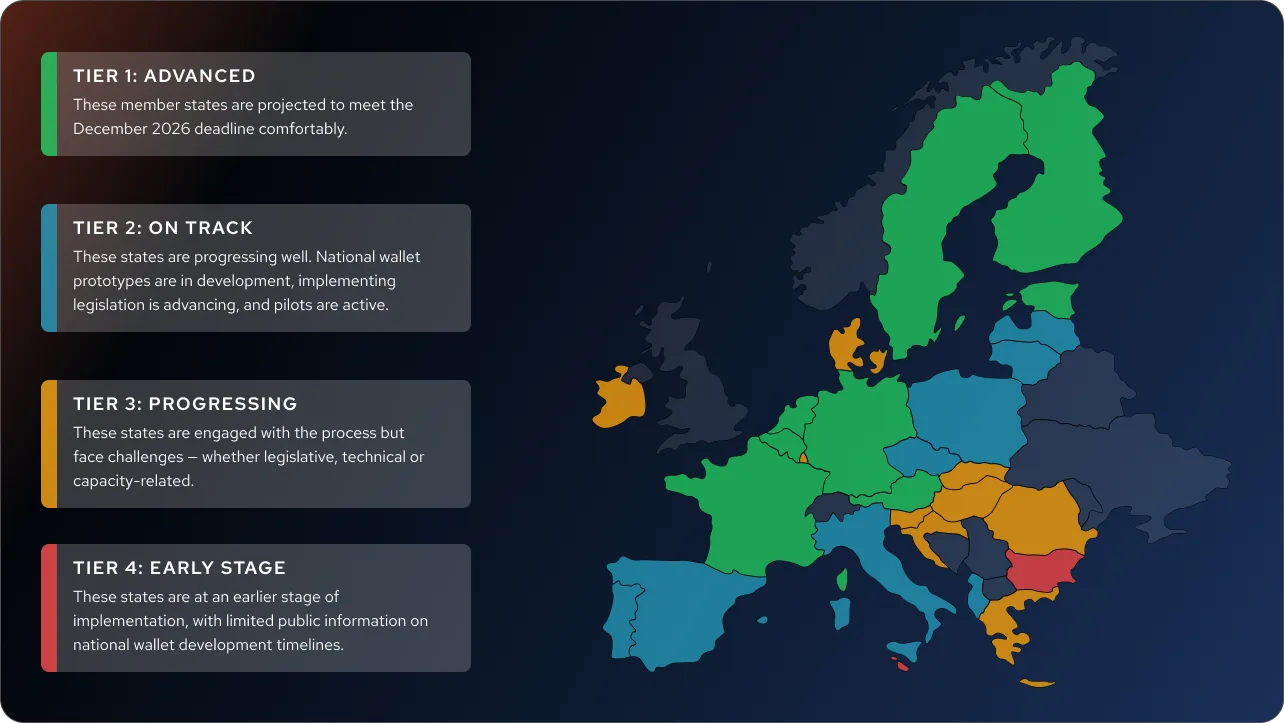
Note: Norway, Iceland, and Liechtenstein — as EEA (but non-EU) members — are also bound by the eIDAS 2.0 framework, with Liechtenstein granted an additional year for compliance. Norway is currently conducting a concept study to determine its national wallet strategy.
“Tier 1 banks should be testing now. Tier 2 banks should be building now. Tier 3 and 4 banks should be choosing their partners now. The deadlines don’t move based on where a member state sits in its EUDI Wallet readiness journey — and neither does the competitive advantage of getting there first.”
Liudmyla Rabchynska, Director of Global Regulatory and Government Affairs at IDnow.
“The EUDI Wallet ecosystem is complex by design: 27 countries, 27 national implementations, one interoperability standard. The banks that will absorb that complexity most efficiently are the ones that have chosen an identity verification provider who is already living inside it,” added Rabchynska.
How IDnow Can Help
As both a technology provider and an active participant in shaping the frameworks that will govern the EUDI Wallet — through LSPS, through ETSI and CEN standardisation work, and through direct engagement with regulatory bodies across Europe — IDnow can help financial institutions enter the EUDI Wallet and AMLR era with ease.
The IDnow Trust Platform brings together market-leading fraud signals and the broadest set of identity verification methods on the market (including each of the three AMLR-recognised methods of identity verification), allowing organisations to meet eIDAS 2.0 and AMLR requirements out the box, with a certified platform that regulators already trust. Plus, thanks to IDnow’s broad portfolio of verification methods, fallback flows ensure onboarding never stops, even when a wallet can’t be used.

Deploy Trust Your Way
National Electronic Identification (eID):
National electronic identification schemes already notified under the original eIDAS framework (e.g., Germany’s existing eID, France’s France Connect+) will continue to be valid under AMLR but operate at national rather than pan-European level.
Discover how the IDnow Trust Platform can seamlessly integrate eID Schemes into your workflows to deliver scalable, compliant onboarding.
EUDI Wallet:

EUDI Wallets are government-issued digital wallets that are compliant with eIDAS 2.0 and contain verified Person Identification Data (PID) and attestations. EUDI Wallets will be considered as the highest level of trust within the AMLR framework for digital identity.
Discover how the IDnow Trust Platform can bring EUDI Wallets into your onboarding flow with one integration, giving you verified, reusable digital identities at scale.
Qualified Trust Services:
Qualified Trust Services are services such as Qualified Electronic Signatures (QES) and Qualified Electronic Seals that issued by Qualified Trust Service Providers listed on national Trusted Lists. Such services are used in document signing and authentication processes and carry strong legal weight.
Discover more about our IDnow Qualified Trust Services.
In the final blog in this series, ’10 Steps that European Banks Must Take to Meet the EUDI Wallet Deadline’, we walk through the operational challenges, the real benefits, and the practical checklist for getting EUDI Wallet-ready before the deadline hits.
By

Jody Houton
Senior PR & Content Manager at IDnow
Connect with Jody on LinkedIn