



Table of Contents
Ready to partner with IDnow?
Turn faces into trusted identities.
AMLR requires regulated institutions to verify more than identity. IDnow’s Qualified Electronic Attestation of Attributes (QEAA) offering will give regulated organisations a qualified way to verify the customer attributes they need – across markets, sources and customer journeys.
For years, financial institutions have invested heavily in answering one question: Is this person really who they claim to be?
A new generation of digital credentials is changing that conversation. Rather than proving identity alone, organisations can now rely on cryptographically verifiable credentials that prove specific facts – such as an address, professional qualification or age – and allow that proof to travel across digital journeys.
The EU’s Anti-Money Laundering Regulation (AMLR) makes that shift particularly relevant.
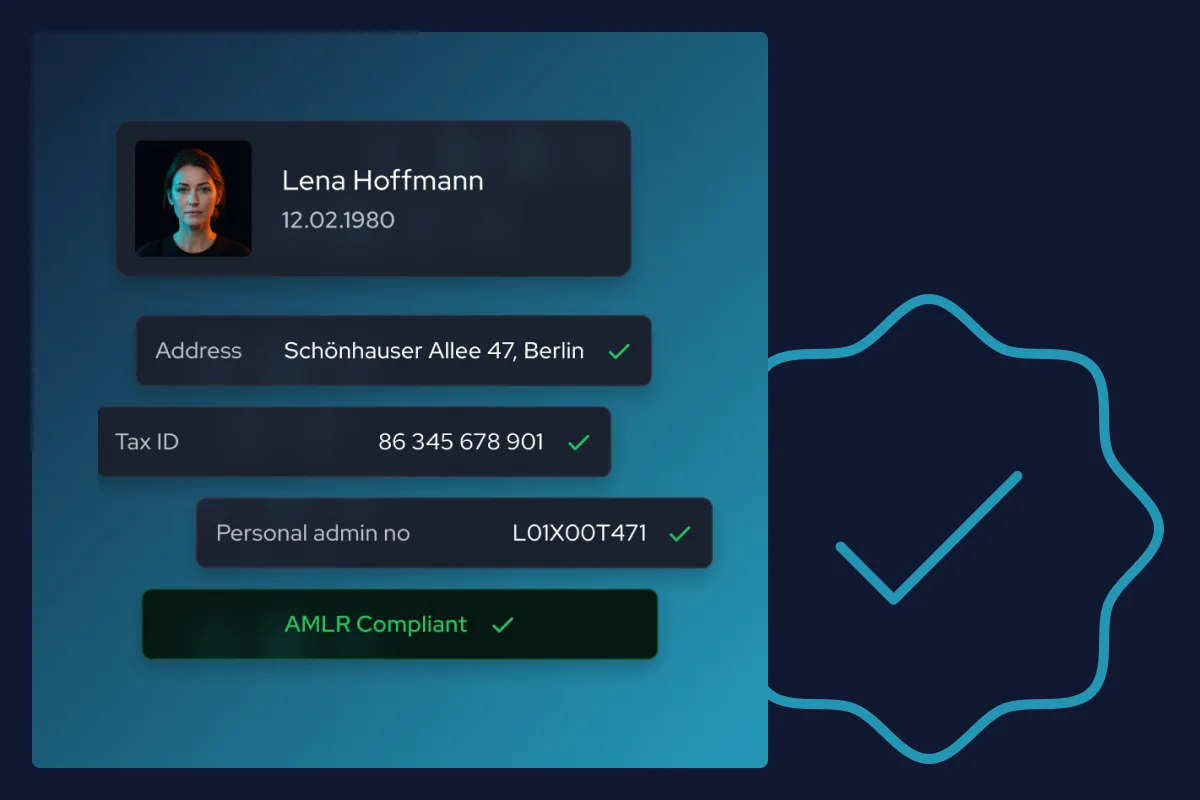
Under AMLR, regulated organisations need to collect and verify specific customer attributes: a residential address, a national identification number where applicable, and a tax identification number where available.
The problem is that these attributes aren’t consistently available through national eIDs as part of their standard PID (Person Identification Data), other identity schemes across Europe, or even future EUDI Wallets. What works in one market may not work in another, leaving financial institutions to fill the gaps with additional documents, data sources and country-specific processes.
The uncomfortable truth is that identity verification alone is no longer enough to operate throughout Europe.
IDnow’s QEAA and EAA offering will help financial institutions bridge that gap.
From Verified Identity to Verified Attributes
Electronic Attestations of Attributes (EAA) and Qualified Electronic Attestations of Attributes (QEAA) are digital credentials designed to prove specific facts about a person. Both prove attributes, but the difference is how much legal certainty they provide. While EAAs provide trusted digital evidence for a wide range of use cases, QEAAs carry the strongest legal presumption under eIDAS, including a presumption of accuracy of the data they contain, making them particularly suited to high-risk and regulated scenarios such as digital onboarding, asset verification and AMLR compliance.
What makes the credential model different is that the proof can travel. Once an attribute has been verified and issued as a credential, it can be presented again in future interactions rather than established from scratch each time. Where selective disclosure is supported, customers can also prove only what’s required – for example, that they are over 18 without revealing their exact date of birth – resulting in less data sharing, less friction and a simpler customer experience.
While AMLR is the immediate driver for financial institutions, early adoption of QEAAs positions them for a broader set of regulated use cases – from income verification and professional qualifications to representation rights – as the credential ecosystem matures.
One Regulation. Twenty-Seven Different Realities.
AMLR is designed to harmonise anti-money laundering requirements across the EU. The way those requirements are fulfilled, however, is anything but harmonised.
The attributes banks need to verify aren’t available through a single European source. A residential address may come from an authorative register in one country, an eID in another or documentary evidence somewhere else. The same applies to tax identifiers, national identification numbers and other regulated attributes.
That fragmentation creates operational complexity. Every new source, market or verification method risk becoming another integration, another process and another audit trail.
IDnow Is Built for Real-World Compliance
This is where IDnow is different. As one of the first providers in Europe certified to issue QEAAs with its own QTSP IDnow Trust Services, IDnow is building its offering around the realities financial institutions face.
Rather than forcing organisations into a single way of proving an attribute, IDnow will adapt the proofing method to the market, the available data source and the required level of assurance.
Authentic registers where available. National eIDs where appropriate. Documents where necessary.
The result will be one consistent attribute proofing journey across markets, not twenty-seven different ones.
Just as importantly, organisations aren’t locked into a single national identity scheme, provider or wallet ecosystem.
As part of the IDnow Trust Platform, organisations will be able to integrate attribute proofing directly into existing onboarding journeys today while remaining ready for European Digital Identity Wallet ecosystems as they mature without requiring another integration in the future.
Combined with IDnow’s identity verification capabilities and Qualified Trust Services, organisations will move from establishing identity to verifying attributes, issuing qualified credentials and preserving them through qualified archiving, all within the same Trust platform.
One provider. One integration. One evidence chain.
The AMLR Countdown Has Started
Most financial institutions know AMLR is coming. The bigger question is whether their delivery roadmap does.
Preparing for AMLR isn’t simply a compliance exercise. It requires new integrations, new customer journeys, new operational processes and development resources, often across multiple markets at the same time.
Preparing also means knowing which regulated attributes need to be collected, where they will come from, how they will be verified and how that process will stand up to future audits.
Every gap in that process can quickly become another integration, another manual workflow or another operational dependency. That work takes time.
IDnow’s QEAA offering will give financial institutions a consistent, scalable approach to qualified attribute verification across European markets, without having to build a different solution for every country.
The same trust infrastructure also supports broader digital credential use cases through Electronic Attestations of Attributes (EAAs), enabling organisations in both regulated and non-regulated sectors to verify trusted attributes at the appropriate level of assurance.
Ready for AMLR? See how IDnow will help companies verify customer attributes.
Continue reading about digital credentials and QEAA:
• The Credential Is the New Passport – Why digital credentials are reshaping trust.
• QEAA Glossary – Learn the terminology.
• Press Release – Read about IDnow’s certification and launch.
Author

Nikita Rybová
Customer & Product Marketing Manager at IDnow
Connect with Nikita on LinkedIn